
Transitions
Inexperience is a choice

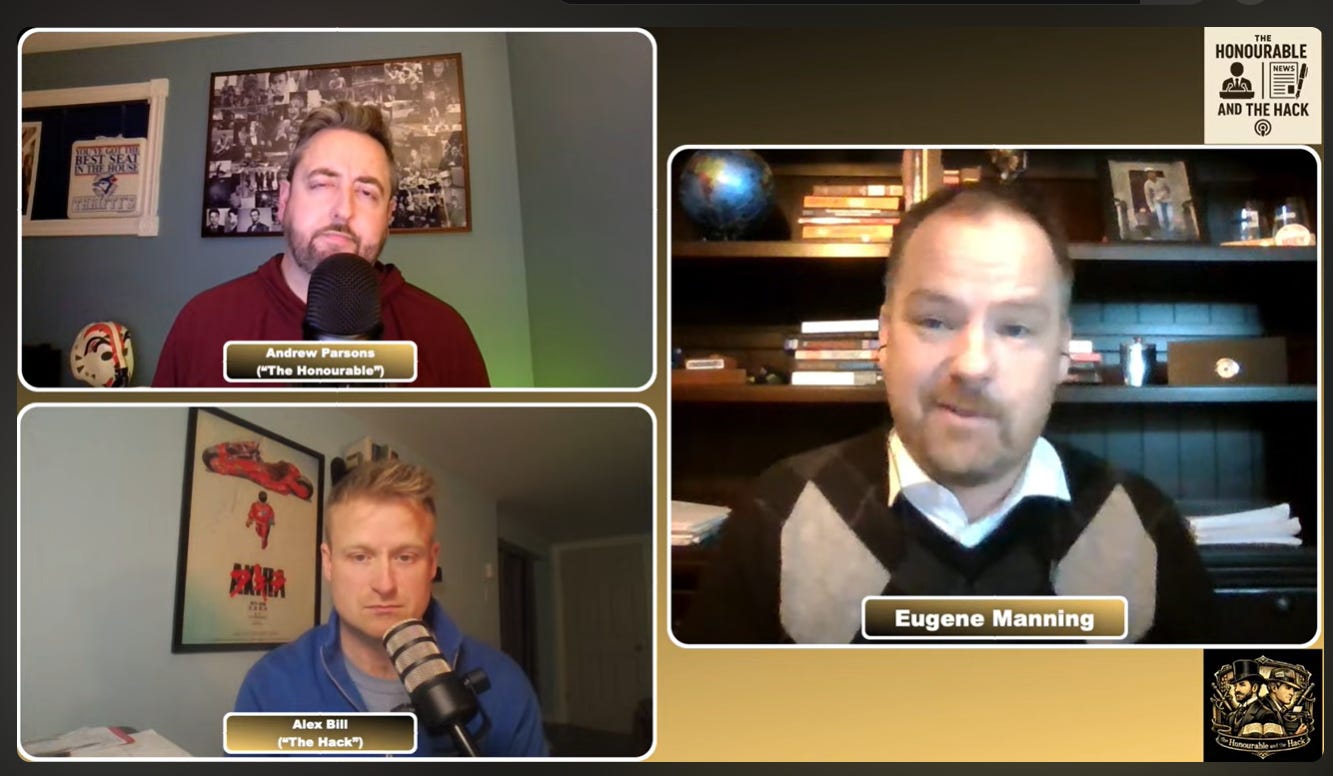
Right out the gate on the new Parsons/Bill podcast, Eugene Manning is talking about transitions and God but it is one of the smartest discussions on local politics in a while. The podcast struggled through two needles-in-eardrums episodes - David Cochrane talking about himself and Tim Powers - but managed to find something bright in Episode Five.
Experience counts and we got a fair appraisal from Manning of the first few weeks of both the Pea Seas and Liberals after the election. The thing was recorded before Christmas so it stands out all the more. Surprise election. Both sides trying to figure things out. Manning gave the Liberals great advice, still. Others have said the same, which is to shut up, rework themselves and come out the gate refreshed later. But the Liberals wouldn’t listen, they never listen, which is why they lost as badly and as stupidly as they did.
What dinged on my ears was the chat on transition and specifically three points that lead you to bigger observations about transitions generally in Newfoundland and Labrador. Having lived through one transition myself and gone through a couple since, I spent some time over the past 20 years working on a side project that involved speaking with political staff, politicians, and bureaucrats about Cabinet, the Premier’s Office, transitions and how they worked on a practical level. I’ve managed to speak with people about their experience going back to almost every administration since the 1960s, including Smallwood. I’ve also looked at what little has been written about those subjects in Canada - it’s very little and only slightly more than about Newfoundland and Labrador, which is nothing - and especially dived into the British memoirs and studies. What follows comes out of all that.
Go for the month-by-month and you’ll pay more. A full year is a greater bargain as most Substacks have raised prices since 2021 at least once. Either way:
There are three points Manning, Parsons, and Bill touch on that I want to tease out.
We’ll figure it out when we get there, or, let’s focus on getting elected first.
There have been three party-to-party transitions in this century alone: 2003, 2015, and 2025. On top of that there have been five intra-party transitions, meaning a change of Prime Minister within a party, each of which involves exactly the same sort of decisions and issues as a party-to-party switch.
By contrast, there were only two party-party transitions in the first 40 years after Confederation - 1972 and 1989 - and five intra-party transitions between 1949 and 2003. To reinforce that point about the importance of switches within parties, Tom Rideout flicked out all of Brian Peckford’s people in 1989 and started pretty much from scratch. Only one person survived the transition and that changes how things operate, leaving aside the rivalries and the animosity the leadership unleashed and that kept the Pea Seas at each others throats for the next decade. In the reverse situation, the sloppy, muddled, half-assed transitions of the past decade with the Liberals meant that the root causes (mostly people and relationships) of all the weakness and systemic problems stayed.
The single common factor in all the post 2003 transitions was that no party or Prime Minister was ready when it happened. They all put it off for one reason or another and never really got to grips with things until after they had the job. The only problem with that approach is that the couple of weeks (usually less than 14 calendar days - between election and oath is the time to act not to sit around wondering what to do. You need to be ready out the gate and in all the 21st century transitions, no one has been, especially in the three party-to-party shifts.
Doesn’t mean they were entirely unprepared. Dwight Ball, for example, had a very well qualified transition team and got good advice. The problem is that he never listened to any of the advice, which is why he was a political wreck out the door and the Liberals staggered through another decade of bungling and fumbling and just spectacularly dumb decisions. One of the trio - might have been Andrew Parsons - talked about how the start sets the tone. Well, 2015 was that.
It’s not an either/or choice. The hard reality is a party needs to focus on both campaign and transition at the same time because taking over government is serious, hard work for grown-ups. There are big choices to make the first day. Ask Tony Wakeham. He and his crowd inherited more major problems/fiascos/crises all alive and snarling at the same time than any Premier in the 21st century and arguably any since 1949.
Day-to-Day Focus.

Closely tied to that idea that transition can wait is the day-to-day focus of parties in opposition and leading up to elections. No one thinks strategically and if anyone in the group happens to be thinking that way, by accident, they will be so alone and isolated no one else can relate to them.
Strategic is not long-term. It’s understanding how one thing ties to another. Think Bilbo climbing a tree in the Mirkwood. Most of the folks who get involved in politics in this century never had to think strategically so they don’t. What they do in opposition or as they get involved with politics and a successful party is just fitting in and going along. They do what they know. The result is a relentless focus on the day-to-day stuff or the transient stuff and seldom if ever on building for a bigger goal.
That tendency to think minute-to-minute carries over through transition when - as a result of thinking they can make it up when they get there - stuff flies at them so fast they struggle to keep up and just settle into a routine of having the next morning as their thinking horizon, let alone the planning horizon.
Inexperience is a choice.
In the discussion, Andrew Parsons notes that folks coming into office don’t have anyone around them with experience in government. Manning talked about the Pea Seas not having people in the caucus or in the staff who worked in government a decade ago.
Generally true. The Liberals actually had some folks with prior experience. Tom Osborne was briefly a minister in Danny Williams’ first mob. Ed Joyce had been in and around government since 1989, having won Bay of Islands in April that year and then taking on the job of being Clyde Wells’ executive assistant before getting back to the House in 1996. Parsons’ father Kelvin was Dwight Balls’ chief of staff.
Danny Williams eventually had Tom Rideout but otherwise his Cabinet was green but not inexperienced. One of his ministers was a former auditor general and his first Cabinet had some experienced politicians in the mix. On the staff side, Williams had some people with experience sprinkled throughout. And Dwight Ball’s Liberals eventually pulled back some old faces but not many.
But here’s the thing: even in a case where the Prime Minister doesn’t have much experience doing anything like the job he or she now has, you can balance that off with experienced staff. There are a lot of them out there, especially when a party has only been out of power for 10 or 15 years. In 2015, the Liberals chose to hire only political staff with no experience in government and in many cases little life experience. It was a remarkable example of a local party copy-catting the federal party across the board just because they had no ideas of their own.
They left in place upwards of 400 Pea Sea political folks according to their own count, the most obvious being most if not all of the comms staff. There was really nothing but weak excuses for doing so and manke no mistake: it was a choice. A deliberate choice. That lack of experience in Balls’ office (even his chief of staff was misemployed as such) not only led to the HST fiasco but the Ed Martin fiasco and the budget fiasco, all of which betrayed a complete lack of basic administrative or political sense.
Tony Wakeham’s crowd have a bit of a different situation. They weren’t supposed to win by most reckonings so the usual ramp-up of interest and people looking for work didn’t happen. They may have a hard time luring people out of comfortable jobs to take on a lot of stress and risk. That’s a real challenge and in a place where being openly partisan can come at a huge personal price when your gang is out of power, the challenge is even greater.
Some of that may be familiar ground for regular readers but it really is worth your while to give a listen to Eugene Manning. Lots of practical political ideas in his head and it comes out in the show.
With the crowd currently running the place, it’s been interesting to see how they are tackling the transition. They are different and how they are working through the same issues as others have faced doesn’t appear to be rinse repeat. Restoring the tuition freeze at Generic Canadian University could be an indicator of bigger things (problems) both from the bad policy itself and how the rest of us learned about it (flopped out by the students’ federation) but the issue is relatively small and the impact may not be that significant. Let’s see how the Pea Seas manage it from here, having fumbled the front end.
There are other, bigger issues to come and we’ll get to some of those bigger issues starting next week.
Ed, ........Strategic you say ; is how one thing relates to another, it is not long term planning. I paused on that for a couple of reasons. I wondered if I think in a strategic way vs long term. I expect both are important.
Given your description, to think that hardly any politician thinks in a strategic fashion is demoralising, given the size and complexity of the business of running the government, its many departments, and so many problems to be solved or improved.
I wonder if your military training has influenced your thinking? Were you 5 years or so with the ROTP while at university?
Have you one or several books near finished to publish?
Last night I came across a book I had not read, it got buried under other books but was important at the time, and I had it signed by the author, Jeffery Simpson in 1988. There are only 14 pages on Nfld as it deals with all of Canada from it's early days. Its titled "Spoils of Power: The politics of Patronage".
Chapter 6 is on Nfld. Its opening paragraph reads:
Newfoundland, perhaps more starkly than any other part of Canada, provides a poignant and comprehensive case study of the infusion of patronage, pork barrelling and corruption into every aspect of political life..........for base political morality, pervasive patronage, persistent venality and even sheer thievery, Newfoundland's rogues' gallery of politicians until recently set the province apart". Given this was in 1988, it ends saying thinks changed under Clyde Wells.
Question; did you have influence with Mr Wells on that matter?