
Three vague goals
on the same course, with the same approach

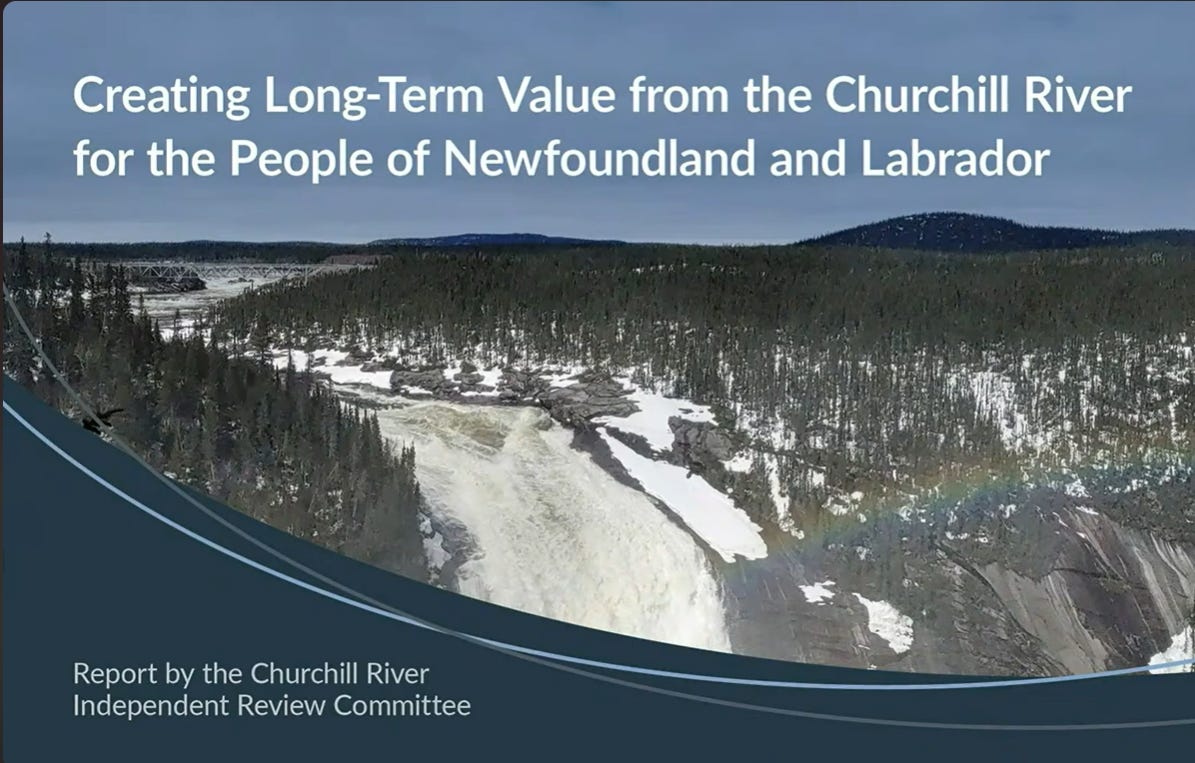
«The history of Churchill Falls is above all one of federalist failures, nationalist constructions, political visions promising empowerment, autonomy, and sovereignty, and multiple colonial relationships taking shape in the construction of infrastructure and the exploitation of resources.»
Martine Verdy, Camila Pantino Sanchez, and Kathryn Furlong, Maitres chez eux: Churchill Falls, la fondation d’Hydro-Quebec au Labrador. PUM 2026
The real news Tuesday was not the release of the independent review committee report on the 2024 memorandum of understanding with Quebec on Labrador hydro developments, but the announcement of negotiations with Quebec to adjust the original memorandum of understanding on three vague points.
The negotiating team of Barry Perry, Jerome Kennedy, and Jennifer Williams are sent to find:
more electricity for Newfoundland and Labrador,
more money for Newfoundland and Labrador from sales, and
more transmission capacity for Newfoundland and Labrador both within the province and through Quebec.
Each of these addresses shortcomings of the 2024 MOU detailed in the report but there are bigger gaps between the report’s major findings and what Premier Wakeham announced.
One of three key criticisms of the 2024 MOU will be familiar to regular readers of these scribbles: “a key decision for GNL [Government of Newfoundland and Labrador] is defining the optimal balance of financial versus economic value that GNL wishes to achieve from Churchill Falls over the coming decades. We believe that future economic development strategy and planning should be led by the government and integrated into NLH’s long‑term infrastructure plans, a key step that was not performed prior to negotiating the MOU.” [bolding added]
Yes.
No strategy before.
And there still isn’t one.
That balance between financial versus economic will come while the talks are happening, which is basically what happened before. and as we all know it did not end well.
Second, the independent review committee “finds that alternative ownership arrangements for developing Gull Island that are commonly used in the energy sector – such as Participation Agreements, Public‑Private Partnerships, and Build‑Operate‑Transfer models – were not sufficiently considered before negotiations commenced between NLH and HQ, and that it would be in the public interest to do so.”
No sign that’s been done or will be done.
Tony Wakeham talked about it but that’s all he did. They still plan to plough ahead.
[continues below link]

Third, was oversight. This is a big one since the oversight arrangement now approved by Cabinet is exactly the one criticized by the IRC as inappropriate and ineffective and it isn’t what’s recommended in the IRC report.
The IRC spends a lot of time walking through the details of corporate governance. Boring stuff to some but really important. If you want transparency, accountability, and ultimately effectiveness, getting the right command and control arrangements are vital.
“In the absence of detailed commercial and policy negotiation targets,” the IRC noted of the problems under Andrew Furey, “the government [that is, the Premier’s Office] actively directed certain negotiation outcomes and required the negotiating team to obtain its approval for key decisions.” In other words, Furey cut out the NALCOR board of directors and ran things himself.
“At various stages of the negotiations, GNL required that several specific commercial outcomes be included in the MOU. The full financial and economic implications of these requirements were not comprehensively evaluated, and they likely reduced the commercial value of the final deal and introduced risks.” NALCOR officials apparently pointed this out but the politicians - that is, Furey and his staff - overruled them.
“In the opinion of the IRC, governance of the MOU negotiation process did not meet the high standards demanded by a project of this scale, complexity, and importance. The governance and oversight arrangements used for these kinds of negotiations can have a fundamental effect on their outcome. Choosing which to apply is thus another central decision for GNL to make as it considers the best approach for future negotiations.” [dash deleted and two sentences created for clarity]
GNL chose but it didn’t take the IRC’s advice. There will be a new oversight committee - yet to be named - that will report to the Premier and energy minister. The negotiating team will report to the oversight committee. NALCOR’s board had virtually no involvement before, something the IRC criticized so this approach just formally tells the NALCOR board to keep its nose out.
This is no small affair since the IRC report specifically deals with the NALCOR board’s failure before and - contrary to what the Premier’s speaking notes claimed - makes no recommendation to replace the NALCOR board oversight of negotiations between the two companies with direct control from the Premier’s Office. To the contrary, the IRC repeatedly blames this lack of clarity and the substitution of political and bureaucratic oversight without technical expertise as a major failure of the original MOU negotiations. Tony Wakeham’s approach repeats the same failed one from Andrew Furey’s crowd without correcting any of the weaknesses lit up by the IRC.
What IRC recommends is that “GNL … establish an independent governing body composed of industry experts that is appropriately resourced and compensated to oversee negotiations. The governing body should agree on a specific mandate and negotiation objectives with GNL, and it should retain its own independent, industry expert support. The governing body should be responsible for reporting to GNL on the progress of negotiations.”
An independent governing body of what? Well, that’s not spelled out precisely and that vague wording is what GNL apparently drove a truck through. In the context, it’s clear IRC meant a new governing body for NALCOR currently doing business as NL Hydro Group of Companies. Stick those two words in and the whole report makes sense. Stick the words “for negotiations” in there and this recommendation doesn’t fit with everything else. The IRC is explicitly critical of political interference and a lack of strategic direction from Cabinet, not for the failure of the NALCOR board to oversee a project that was - like Muskrat Falls - entirely political from the start. The NALCOR Board then as now stayed out because - as political appointees - they understood their job, just as Dennis Browne did, is to take direction not give it.
Just to reinforce this gap between what the IRC recommended and what GNL is doing, IRC cautioned that Wakeham and his Cabinet “should be aware of the risks of actively intervening in commercial negotiations once objectives are defined and the negotiation mandate agreed on.” Then they added the advice that “GNL should also consider retaining its own industry experts to provide impartial, informed advice independent of the governing body.”
That’s even more oversight and frankly, it’s 100% in line with what Mike Wilson has said about governance since he went public after quitting in the Furey farce. That would also explain why the panel didn’t show up for the newser to talk about what they found and their recommendations.
[continues below link]

For the rest of Mike Wilson’s critiques and commentaries, search here for “Michael Wilson.”
In the Premier’s speaking notes there is a simple fact - the “Report of the IRC makes it clear that the Board of Directors of Newfoundland and Labrador Hydro did not exercise sufficient oversight over the negotiation of the MOU” - but then it adds a falsehood: “and recommended that this oversight be moved away from the Hydro Board.”
The IRC didn’t recommend that at all.
Not once.
Quite the opposite.
The IRC recommended a new Board of Directors - the governing body - and separate expert advisors for both the Board and Cabinet. This is a big project and that approach would be consistent with both the IRC report and the Muskrat Falls inquiry report.
In 2019, Bond Papers noted that Muskrat Falls “ was only possible as a result of the relationship between NALCOR and the Premier’s Office. It is a relationship that dates from the creation of Newfoundland and Labrador Hydro in the mid-1970s and that only grew deeper after 2003. That close relationship made it virtually impossible for anyone inside government to question the project no matter how obvious the problems with it might have been.”
To fix the problem, I suggested that at “the very least, the relationship between the Government of Newfoundland and Labrador and Newfoundland and Labrador Hydro must change fundamentally. The corporation must be re-organized so that it can be run as much like a private sector corporation as possible. Its shareholders may give general, clear direction but the provincial government should deal directly and almost exclusively with the board of directors to ensure government’s objectives are met.”
That’s not radically different from what the IRC recommended. But what Tony Wakeham is doing is what every Premier since Brian Peckford has done. Sometimes it worked out okay. Other times, especially after 2003, it’s led to disaster. The decision is based on a fallacy, a falsehood that, as the Premier’s speaking notes read, it “is ultimately my responsibility as Premier to define the negotiating position of our province.”
Cabinet government is collective government. Muskrat Falls was the result of a one-man band. The original Churchill Falls MOU was the result of a one-man band. The Premier - or whoever advised on this decision - hasn’t learned any lessons from any of the major Hydro horror shows of this century. NALCOR and before it Newfoundland and Labrador Hydro had a special relationship with the Premier’s Office. That became more pronounced under Danny Williams with Muskrat Falls and continued through to Andrew Furey.
With Muskrat Falls, Commissioner Richard LeBlanc accused the NALCOR crowd of taking advantage of the political and bureaucratic naivety: “GNL’s oversight of Nalcor was weak, at best. GNL was the owner of Nalcor but nevertheless allowed Nalcor to be the dominant player in the relationship. Nalcor officials knew that the GNL officials and politicians who worked on the Project were considerably over their heads and unqualified to evaluate cost, schedule and risk. Nalcor officials took full advantage of this serious and glaring weakness when they should have recognized that this imposed on them an even greater duty to ensure that GNL was fully informed and understood the cost, schedule and risk.”
LeBlanc never understood or admitted that Muskrat Falls was a political project. The politicians and bureaucrats may have lacked the technical knowledge needed to judge the project but they also didn’t care about anything except building the project. Muskrat Falls was Danny Williams’ personal hobby horse, nothing else.
In dealing with the Furey MOU, the IRC was explicit in its criticism of essentially the same situation: “GNL oversight and intervention during negotiations effectively superseded the NLH board’s governance role, contributing to a riskier and more expensive deal. In the opinion of the IRC, governance of the MOU negotiation process did not meet the high standards required by a project of this value, complexity, and importance.”
What’s important in that IRC report is that the IRC notes that the effective governance of negotiations would be for Cabinet to set broad strategic goals and then leave the execution of the technical details to the Crown corporation. That’s bog-standard sound governance.
…[A]lthough Crown corporations are designed to advance policy objectives of the government, they generally do so with more of an arm’s‑length involvement by government since they are also expected to achieve stated commercial objectives and to function like businesses. In some other jurisdictions—British Columbia, for example—Crown corporations are given annual mandate letters describing government priorities, then strategic and operational decisions are left for the board of directors to oversee. [Emphasis added]
Clear strategic direction is hard. That’s why Danny and Andy didn’t bother with it.
Now we have the government following essentially the same path as all those since 2003 with only the direction to future negotiators to get a slightly better outcome on cash, electricity, and transmission.
Otherwise, it’s the same basic deal with a few tweaks. As someone noted at the news conference, Jennfier Williams already told us the deal she brought to the House of Assembly is as good as it gets.
Now Tony Wakeham looks to make it gooder following exactly the same approach and with all the strategic flaws of the Furey MOU - the stuff about Quebec control - all intact, apparently. He talked a lot about control of our resources but the three goals are just about tweaks.
That’s the real news of Tuesday and the MOU.

When you don't know where you're going, any road will take you there.
A few days ago, I did a "Report". I call it " Turning Labrador from the land that God gave to Cain, to a land that is "Greener than Ireland". Its about 25 or 30 pages, so 1/4 that of the present Report just released. I had considerable assistance from Gemmeni AI, which did most of the calculations. My time was over 2 days, but broken up and probably less than 8 hrs total, if it was continuous, There were advantages and it was necessary to take the pauses, unlike AI which runs 24/7.
Did I hear right that the IRC report cost 900, 000? So averages 300,000 each?
My report cost, as to AI energy, it cost came in at less than 15 cents, and was no charge. It processes data in milliseconds and responds to the query. Of course, it makes booboos, and I caught several and there are likely more.
Gemmeni suggested my assessment was valued at about 1 million, and youmay kn ow that its butters up those using this technology. I had hoped it may be worth 2 cents, that is 2 Nfld pennies.
I am pretty slow, being an "old geezer" that tries to reflect on the query and the answer from AI.
Yours was one of about a dozen names the AI recommended to review my "Report" if it has value, for our "Leaders" or the public.
I have not yet mastered how to save this document but might figure that out.
Any interest in reading it?