
This week has two Mondays
And two Fridays

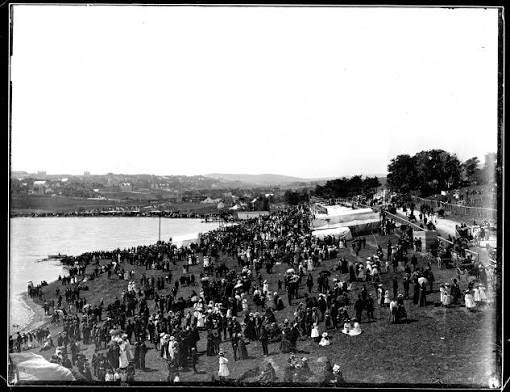
There’s a reason Regatta Day happens on Wednesday.
St. John’s businesses worked Monday, Tuesday, and Wednesday morning. Then they worked Thursday, Friday and a half-day Saturday morning.
Holidays in the British fashion came on the Sunday nearest the important date and that was already the day of rest.
Anything else, like Regatta Day, meant employees only had to lose a half-day of work from the employees.
August 1914 was exactly the same as August 2026. Regatta Day will likely be on the 5th. The Great War started on Tuesday, August 4th but the government had been slowly organizing and setting up defences according to plan written before the war. London had sent a warning telegram on the 29th of July to all colonies and Dominions to get ready. “Adopt Precautionary Stage” it read.
There was a plan already to use the sectarian boys brigades as the recruiting base for any overseas contingent. The Cabinet made that decision long before Walter Davidson became governor in 1914 but it has become a popular mistake locally to believe that Davidson did it all.
It’s also popular to think Newfoundland was just a colony ruled by British overlords and that the locals decided nothing. Not so. Newfoundland, as it was then know, decided to send troops in 1914 just the same as in 1899, the government refused to organize local volunteers into a battalion although the governor at the time - Henry MacCallum - was incensed that the government would not do as he demanded. Local self-government meant just that. Canada decided for its own reasons to send soldiers to South Africa. Newfoundland did not, largely because there were serious disagreements between Sin Jawns and London.
The Cabinet met on Thursday, as usual, without the Governor, as usual, and a telegram went off to London on Friday in the governor’s name offering sailors from the local naval reserve division - straight out of the war plan - as well as a contingent of soldiers, if needed. That offering of soldiers came from the strong local sentiment just as there was at the same time a patriotic rush across the Empire of men offering or being pushed into volunteering.
There was no plan at that point for a whole battalion, let alone the two raised eventually. The British replied right away: hang on with the sailors but get those soldiers as soon as possible. The government hired a local lawyer involved with the Catholic Cadet Corps - Charles Conroy - to draft what became the law under which the volunteers served.
Two physicians - Cluny Macpherson and Arthur Wakefield - screened volunteers at a hastily organized camp at Pleasantville using a Royal Navy blue book for health standards. That meant they screened for soldiers smaller in chest measurement and height than the minimum British army standard at the time and still they screed out half as being medically unfit before they found their 500. The Newfoundland government met the Newfoundland people for the first time.
The first contingent went overseas, tagged onto a Canadian convoy in early October. Recruiting for a second contingent started almost right away and by the spring, the Newfoundlanders had the thousand men needed for a full-sized battalion. When the Newfoundland government offered the soldiers in August 1914 they had no idea how many men they’d need, what it would cost, or for that matter how heavy the standard service rifle was. They also had no idea how long the war might last. No one did.
At the same time, the government was fighting with the British to free shipments of Newfoundland fish seized in British ports under wartime regulations to let them get on to markets in allied and neutral countries. That would take months to sort out and hindered the national economy severely at a time when the country was also sending soldiers off for a war that might drag on beyond Christmas.
If that were not bad enough, the Newfoundland government also had a governor who thought he was in charge. Walter Davidson thought much of himself and told his diary so. Later historians would mistake his private musings for fact and so many written histories of the war have fundamentally misunderstood what happened as a result.
Prime Minister Edward Morris used Davidson as a prop to head the Newfoundland Patriotic Association, thereby avoiding the domestic political trap of sectarianism and party politics by making the outsider the symbolic head of a fundraising and administrative group to manage the bureaucracy of the war. Davidson misunderstood his role and talked wildly, publicly of plans and designs including the announcement of a home guard battalion even though there was no need for one, there was a struggle to recruit soldiers and sailors for overseas service, and, as Davidson knew, the government could not afford to have both the overseas contingents and a domestic one at the same time.
Privately, Morris scolded Davidson for speaking out of turn and threatened to expose him publicly as foolish for knowingly doing so were he not to retract his statements and stop the going off half-cocked. Davidson left Newfoundland after four years. In public, Morris praised the former English colonial civil servant in the Far East and Africa for “going down into” what he called “the hurly-burly of department work” with the administration of the war effort that had taxed the small Newfoundland civil service in the beginning.
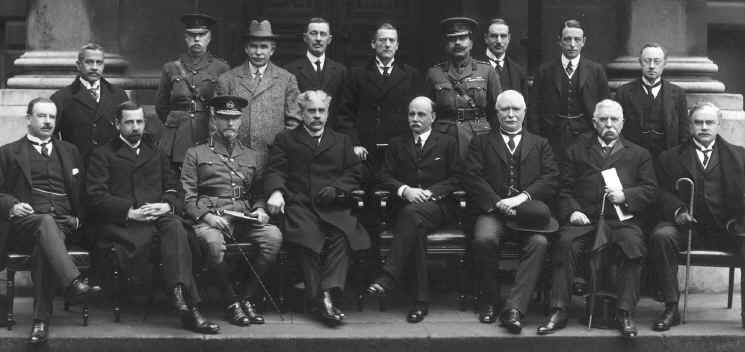
Davidson left in 1917 and by that time, Morris himself was gone from Newfoundland as well as he took up the job of serving on the Imperial War Cabinet in London. That’s him in the photograph, seated second from the right in the front row of the image below amongst other Dominion Prime Ministers at the Imperial War Conference in early 1917. Davidson became the permanent representative as Newfoundland did not have a high commissioner in London at the time.
But in that summer of 1914, those days were in the future and all anyone knew was that in the midst of great deal of international excitement and uncertainty a day at the races would give them a short and welcome day of normalcy.