
The Big Picture '25
Looking to Monday and beyond

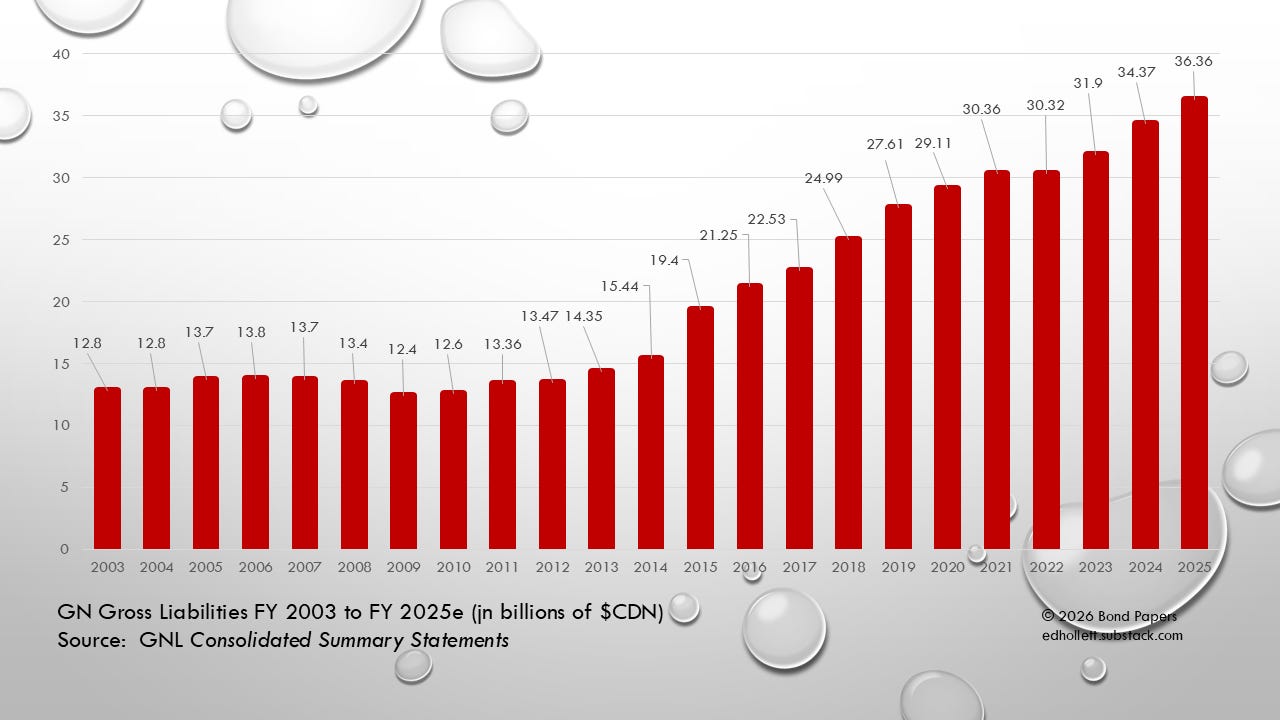
In 1933, $100 million of debt killed self-government in Newfoundland and Labrador.
Public debt today is 380 times more.
Monday there’ll be the start of a new sitting of the House of Assembly.
First after the election.
First meeting with the House for the Tony Wakeham mob running the place now.
And so a throne speech and eventually a budget.
This will hopefully return us to fundamental accountability after the Furey mob ditched it for as lot of posturing and more than a bit of arrogance and authoritarianism common to our time, unfortunately. They only delivered budgets because legally and constitutionally they had to but avoided what should be an annual throne speech for two and a half years. Regular readers of these scribbles will already know the litany of other faults of the other mob, including ramming legislation through the House daily before anyone - sometimes including themselves - had a chance to know what the hell they were doing.
As we all look to what’s coming, keep an eye to the money.
Danny Williams and the Pea Seas in 2003 had a pretty good thing they inherited from the Liberals. Total public liabilities were a shade under $13.8 billion in an economy worth $16 billion and growing. There was a deficit of $350 million but that was relatively easy to manage as oil prices were supposed to grow and oil revenue was growing as new projects came online. Plus, we were less than a decade into oil production so the future was fat with easy opportunity if the new ruling crowd managed things prudently.
They didn’t. Overspending started in 2006, built on booming oil revenue. As with Alberta governments, they built fixed spending on unfixed income. Long-time readers may remember a critique here of Wade Locke’s Prosperity Plan for the post-Danny Pea Seas. Wade proposed running deficits and surpluses as needed over a decade and in that way things would average out to a balance.
What Locke ignored was reality. For guv’mints in this province, spending is a one-way valve. It only goes up. All the new debt built up in those leaner revenue years would just add to a pile of debt that never shrank. Arguably, what the Pea Seas had been doing and every government afterward kept doing was a version of Locke’s logic. They just left out the modest trimming and the modest deficits to make the little model work. So debt piled up.
Locke also used net debt as a target even thought it is a nonsense notion. That link to the old Bond Papers is worthwhile because, like the Locke one, it goes back to 2013 when there was a giant deficit that added to the jump in total liabilities.
People at the time blew it off as nothing and put it down to Muskrat Falls. What they didn’t admit is that overspending was the root of the deficit and debt problem, had continued to be a problem at that point, and would be one on into the future. Meanwhile, their optimistic projections for Muskrat Falls proved to be wildly wrong, as was plain at the time.
By the time Danny ran from office in 2010, he’d left behind Muskrat Falls - the bulk of which isn’t in these gross liability numbers - and a slightly smaller set of liabilities. It wasn’t really smaller since the subsequent steep climb in debt was just a delayed impact of bad policies Williams started. He’d been able to paper over the problem with oil cash but once the oil tide receded the bones of the monster started peaking above the waves. By the time Kathy Dunderdale was closing the financial deals with Ottawa on the Muskrat - there’s that fateful year of 2013 again - those gross liabilities had grown to the Williams-era peak of nearly $14 billion. A year and a half after Williams left and things were going sour again despite solid oil revenue.
Liabilities kept growing such that by the time Dwight Ball and the Liberals took office in 2015, the public owed just shy of $20 billion. The back-end of the Pea Sea period added almost $7.8 billion in new debt in just five years.
By the time Dwight Ball ran from office with his caucus chasing after him with knives, the total public liabilities had grown by just shy of $10 billion in five years. And when Andrew Furey left a flaming bag of dog turd on John Hogan’s front porch, the total public liabilities that went with the Premier’s job were about another seven billion dollars higher still.
$24 billion in 15 years.
It took the century and a half - 148 years to be exact - between 1855 and 2003 to pile up. The crowd after Danny Williams added double that in one tenth the time.
$1.6 billion in new debt, on average, every year from 2010 to 2025.
In a smidge over 20 years - from 2003 to 2025 - public debt tripled in Newfoundland and Labrador. Three times as much now as then, give or take a buck. Andrew Furey’s last budget left taxpayers with a forecast of almost $38 billion hanging around their necks.
That figure, taken from the official government additions each year, isn’t everything we owe. Moya Greene’s report for Andrew Furey told him that the “total debt of government and all of its entities is rising quickly and currently stands at $39 billion.” The Premier’s Economic Recovery Team noted that annual cash “deficits in the last five years have averaged $1.9 billion annually. The province has added $12.6 billion to its debt over just the past seven years.”
That was actually a wee bit light but if you had that calculation in 2020 or 2021, you could safely add another $7.0 billion on top of the official number from Furey’s last budget and you’d be closer to the truth today. That would be close to $45 billion owed by the 530,000 people who live in Newfoundland and Labrador when Andrew Furey went off to lecture students about leadership.
$45 billion in an economy with a total value of $35 billion in 2023.
In the early ‘90s, the place was in a panic when we owed a buck for every buck the local economy produced every year. Now we are at a buck thirty in debt for every buck produced.
The government has a huge financial problem.
Massive.
And that means each Newfoundlander and Labradorian has a massive problem.
The cause is chronic overspending that started in 2006 and continued without any slackening. All through the Liberal period the annual deficits - spending more and more beyond what the government had as income - grew until by the Furey years, the government was racking up debt of at least $2.0 billion each year.
That causes two main problems. First, the debt makes it harder for the government to borrow money in what is already a very small market for our debt. We also have a hard time getting debt at good interest rates, which means we pay out more just in interest each year.
That leads to the second issue, which is that the cost of servicing the debt eats money that we could be spending on services people need. Another way to look at it is that half of what we are borrowing - around $2.0 billion a year - goes to pay off interest and other debt-related costs. You can see that in this Sankey chart of the 2024 budget.

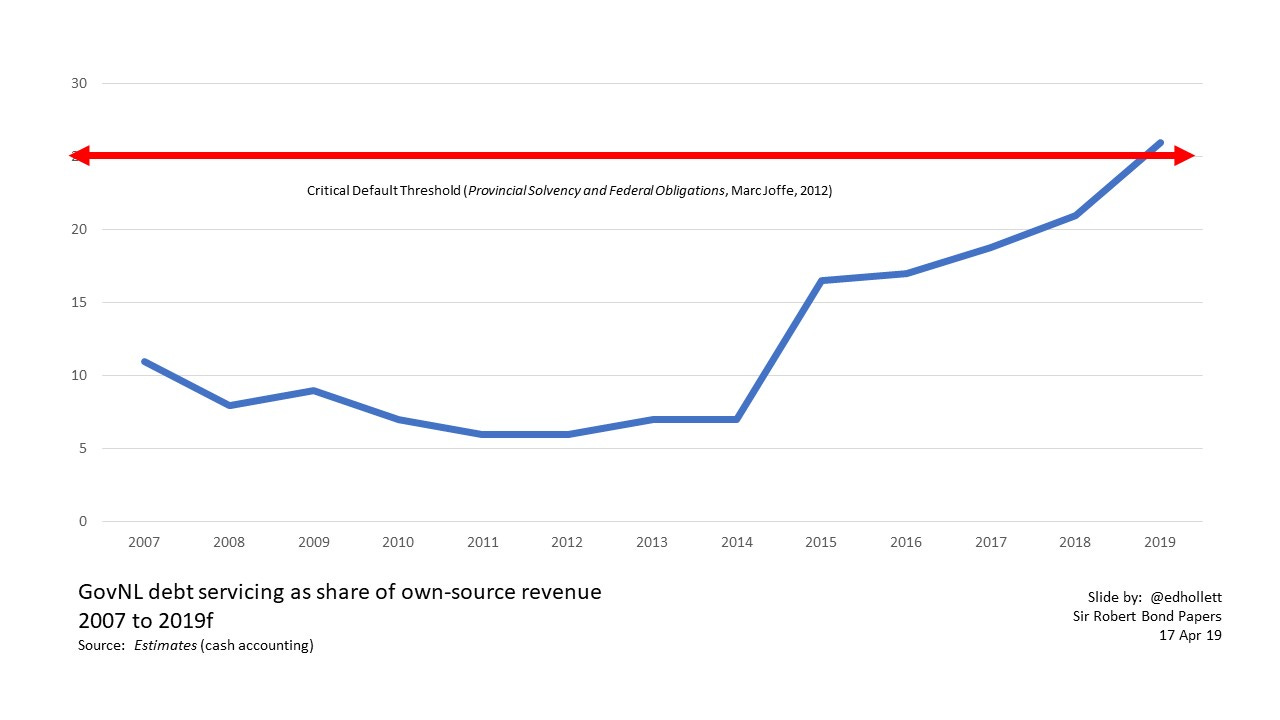
Those problems are ones I have been writing about for years. Here’s a 2019 version of a chart that showed the share of the governments own revenues (not including federal transfers) taken up by just paying the interest on the debt. The red line shows the share identified by researcher Marc Joffe in 2012 as being the trigger for potential financial collapse by the government as markets shied away from loaning the government money. In March 2020, totally separate from the pandemic, the provincial government couldn’t raise money in the markets. Dwight Ball wrote to the Prime Minister begging for help as the government would not be able to pay salaries. Not long after, the government changed the way it reported debt expenses to make it harder to make that calculation shown in the chart.
That’s all there is for this one.
We’ll just let it sit there.
Just remember that the pattern of overspending actually began in 2006 during that time when Danny Williams looks in hindsight like a decent job of managing public money. He boosted spending based on oil money, which really comes from liquidating an asset. None of it went into any investment to earn more money and so what Williams' era Pea Seas did was increase fixed costs - new hiring, health care, debt servicing etc. - with temporary cash and then borrowing money to cover things off when the temporary cash stopped flowing. every single government afterward, regardless of party, did the same thing.
What we need to watch for is what these new guys do.
After all, debt sank Newfoundland self-government in 1933. And while the Canadians are there now as a backstop, there’s no guarantee we won’t ourselves a century later without the ability to government ourselves again.
Not sure I ever read Ed's piece in the afternoon, always early morning. Reason: a bit much engaged in aspects of electricity, as to our grid, and our planet. Then the trip on the LIL, and I wondered if it was caused by GICs, where our grid was already vulnerable to massive solar flares well before Muskrat. For those familiar, recall the 1989 HQ outage too.
As to the enormous debt being a burden on all residents.........well not equally. Say, a 50,000 or 100,000 dollar public debt per resident, implies not a big impact on the well off, but more so on the poor, who cannot help repay it, but also reduced government services, especially social assistance, and falls most on the middle class. On the health care side, likely affects all as the health care crisis deepens. Yesterday, while disabled people incurred costs and managed to make it to the HUB for care, yet by 11 am it was closed down for basic care. Why........a little snow and even wheelchair taxis operated, and had no intention to stop, as the weather was a minor incident. The HUB staff........were they then given a holiday, or so few came to work that they could not operate? This fiasco under the new PC government, deserves an explanation.
I don't like it either but our politicians (and voters) have shown their preference for high deficits over a balanced budget. But maybe it's actually brilliant despite being morally decadent. And it's worked for the last twenty years!
Here is our collective thinking: enjoy high deficit spending until the debt markets revolt and cut off our access to further credit. When that time comes we are forced to balance the books but that's a future problem so who cares. Lots of us will have aged out (died) by then and the rest of us can move to the mainland and avoid the cuts to services and higher taxes. Our only losers are the skeets, drug addicts, and other poors that can't afford to move. (And of course we don't care about the big investment funds that are stupid enough to buy our debt.) Eventually there's a bailout as debt holders write-down the debt and/or the feds swallow it - voila, the debt is restructured and life can gradually return to normal. Survivors move back to the Rock and some years later we go back to high deficits again. Party on!