
Our past is our present
as we shape our future

Our story matters.
The stories we tell of ourselves are important.
It teaches us who we are. It shows others how to treat us.
In the darkness, the images flash on the screen.
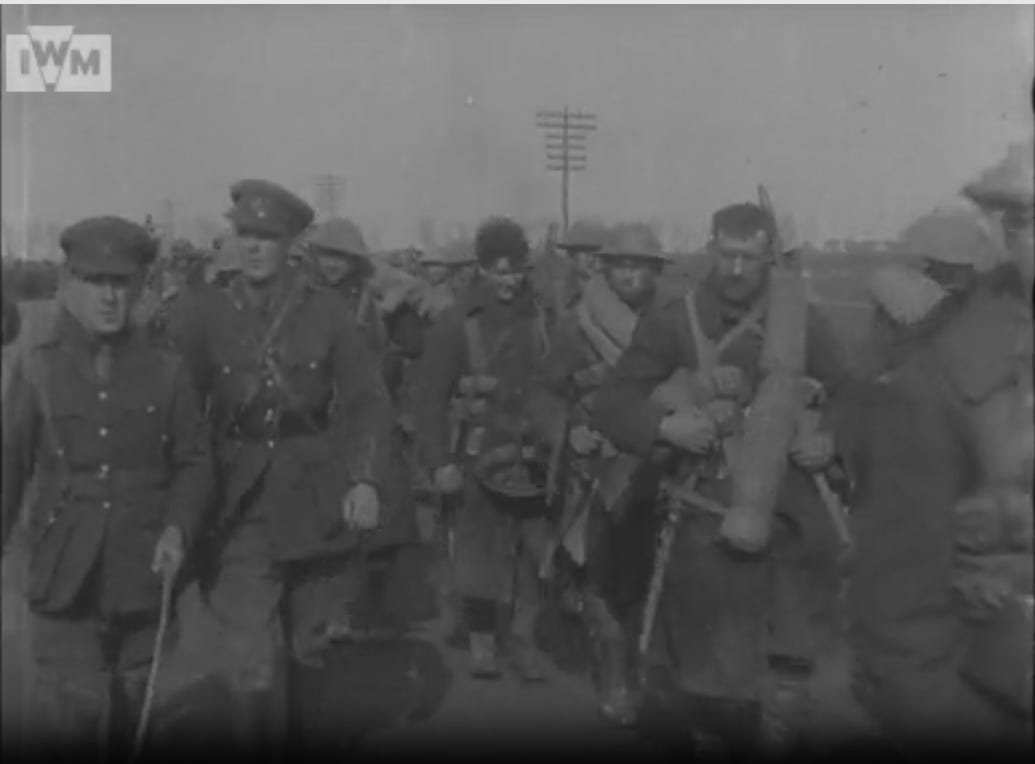
Men. Tired men. The long coats and tin helmets of soldiers. Some are missing helmets. All have rifles slung on their backs along with bedrolls, ammunition, rucksacks, spare socks, and everything else they need to live.
Not quite bent double like old beggars but still…
Tired faces.
Familiar faces.
The first soldiers anyone sees in Peter Jackson’s They shall not grow old are Newfoundlanders.
There are no names in the movie. No way to tell who they are. Jackson has turned the images around from the original, shown above, with the left on the right and right on left.
But still.
If you know them, the faces are familiar.
Unmistakeable.
Familiar because you’ve seen them before in books or articles about Newfoundland and Labrador’s part in the Great War.
Unmistakeable because the faces - the soldiers and officers alike - all look like people you grew up with or met somewhere, sometime.
If you are from Newfoundland and Labrador, that is.
Newfoundland or Labrador.
The film is from May 1917, a month or so after the battle at Monchy-le-Preux in which the Newfoundland battalion was almost wiped out by the Germans for a second time in less than a year. Decimated but back in the line with new men, young men looking like old men.
One thing at Beaumont Hamel but at Monchy the battalion was different, the way they fought was different, and the outcome different. While most of the battalion was killed or wounded, a small group of soldiers centred on the battalion headquarters fought off a German attempt to encircle the flank of the British line. There were nine Newfoundlanders and one soldier from the Essex battalion. They earned the name “the men who saved Monchy.”
That’s likely not a story you know. You likely know all about Beaumont Hamel. Slaughter, stupidity, doing as they were told. Following orders to the letter even as they got cut down. Gallant sheep led to the slaughter at the hands of foreigners.
At Monchy, the Newfoundlanders used rifle and machine gun fire alternately with movement in small groups, to get forward, following a hasty plan. Nothing at all like the summer before. Nothing. In truth, nothing new since the Newfoundlanders regrouped and went back to the line in October 1916 at Gueudecourt using the same new tactics so, by the following spring, they were well used to fighting in this more sophisticated way. Learning. Not waiting for orders. Not following a script.
Two years before, the crowd at home wanted a committee in Sin Jawns to appoint officers based on religion but the soldiers would have none of it. They wanted leaders who they could trust, regardless of what church he went to, what family they came from, or what they’d done for a living. When they got home, the survivors created a university. A non-denomination school to help build their country for the future.
Monchy-le-Preux is such a stark contrast to Beaumont Hamel in so many ways, it’s amazing that the story has all but disappeared from both official and popular memory about the war. Then again, when the official 100th anniversary commemoration of the war ended in 2016, not 2019, and when people assumed the Unknown was from Beaumont Hamel when he was inf act from Monchy, it is hardly surprising. Indeed, given the Newfoundland and Labrador story of the Great War it’s striking how much of the war and Newfoundland’s war experience is buried under the Beaumont Hamel cult’s obsession.
There are plenty of other examples like Beaumont Hamel. Stories from Newfoundland and Labrador history that are either misrepresented or ignored. Confederation - not a conspiracy yet a book and a movie say it was - Indigenous people, Africans, Churchill Falls. Even what Newfoundland was legally and constitutionally before 1949. The stories told are invariably derogatory, derisive, and wrong. They come with all sorts of sneering condescension. As much nonsense as Tibb’s Eve and insulting as Screech ins and other boozy marketing scams. The stories, like the demeaning minstrel shows of cod and gibberish and rum, are told by outsiders as well as locals with all the same attitudes and the same ease with which people from here call themselves Newfies and do not see they are the joke not just in on it.
Our interest in this column is not in why people say things that are easily proven false,, why they make fools of themselves, their friends, neighbours, and families. Some of it is ignorance. Much more is stupidity, which is the only name for it. More still is self-serving and greedy and gives the tale-teller some advantage personally. Far too much is malice.
What matters for this moment is the impact of the words and ideas on the people talked about. In some versions, particularly the so called “nationalist” view, Confederation, Beaumont Hamel, and Churchill Falls are the unholy trinity of foreign exploitation of Newfoundland. The three great examples of how foreigners come only to steal from and fool Newfoundlanders.
There are variations on the theme of exploitation. Some are as outright ridiculous Barbara Doran and Lisa Moore’s film Hard rock and water. Only one blames obviously imaginary foreign demons, in that case foreign magical forces like the boogeyman as in Steve Crocker and Lisa Moore’s Muskrat Falls.
All of these is “nationalist” arguments are, like all fairy tales, built on some element of truth - people are trying to take advantage - but that is irrelevant. The tales of foreign demons and exploiters are not about the fporeigners but the locals. They tell the locals they are stupid, dupes, rubes. They need someone to run their lives. And all that just helps a small crowd of locals run the rest. They control the public debate within Newfoundland and Labrador. It frames what is supposedly legitimate and what is illegitimate. Happened in the 1970s and happened in spades in the Danny Williams era.
On its own, the myth - whatever myth you pick - doesn’t do the work. You have to add old aspects of the political culture, the ones that separate classes and give each a role, whether leader or led and make sure people kjeep their heads down and do as they are told. Some were everyday culture, which survives today in the preference for doctors, lawyers, or business people as politicians even though given the last 20 years of experience the lot of ‘em couldn’t run a whorehouse and make money. Some of the betters, now including university trained managers did bankrupt a Tim Horton’s if you want a more demure comparison.
Some of the class division - the bias and bigotry - used to be baked into the rules, like the property qualification at elections. All adults could vote but only those with property could be candidates. Genuine universal suffrage and universal adult candidacy didn’t come until until the 1940s, when Labradorians got the vote too. All adult women could vote by the mid-1920s, regardless of race, but only women with property could be candidates. These days the rules still favour people with money, whether as candidates or those who control candidates and parties.
In its own way, the Beaumont Hamel myth reinforces the idea that ordinary people best know their place, which is to follow their betters, faithfully. It’s very much the same as the Sturdy Baymen attitude that crops up now and again. Baymen - the local symbol of the working class - are best presented when they are reliable, dutiful, and obedient. When they step out of line, the political reaction - which is inevitably a class-rooted reaction - can be as extreme as the parade of armed police around Confederation Building as the lawyer and doctor at the apex of power blustered to the microphones condemning a peaceful protest as violent. The events of the 21st century but the images clearly of the nineteenth.
The Colony myth - Newfoundland was a British colony in 1949 (it wasa Dominion like Canada, but with a suspended constitution - is a version of the old anti-Confederate one. In the Canadian telling, Confederation was about taking in the benighted cousins, the impoverished wretches and saving them from their own laziness and incompetence. It helps Canadians and local elites to keep the Newfies in their place now to remind them of their powerlessness then and their supposed poverty now. Like John Crosbie over Meech Lake warning us not to “bite the hands that feeds” us. Or Dwight and then Andy claiming they deserved power just because they had friends in Ottawa with money who might give us a handout. Begging letters to Ottawa become cam-in-hand, tugging forelock policy as belittling as it could get.
The traditional Newfoundland nationalist line does not empower Newfoundlanders and Labradorians, either but reminds them of their stupidity: always fooled. Always electing stupid leaders. Ah but this time you will get it right, the myth peddlars would say as they stepped on and off what is a rhetorical carousel. Then the next out crowd would say the same thing a few years later about the in crowd.
As your humble e-scribbler pointed out more than 20 years ago in the original version of the Spindy, in “his victory speech a few weeks ago, premier-elect Danny Williams pledged that Newfoundlanders and Labradorians had voted to seize control of their destiny using words eerily reminiscent of Smallwood, Peckford and Tobin. ‘There will be no more giveaways. The giveaways end right here and right now!’”
“Why are we stuck on this rhetorical merry-go-round?” I wondered.
One reason is that political leaders take a Calvinist approach to history. As Calvin told his stuffed tiger Hobbes many years ago, people reinvent history to suit modern prejudices and to fit modern needs. We spin our history, old and new, reweaving the threads of fact to suit the immediate need. Tories blame the Liberals for job cuts in the early 1990s, conveniently forgetting the world recession, and the abysmal state of the province’s finances. New Liberals blame old Liberals for the Upper Churchill give-away. Nationalists blame foreigners for everything from the collapse of responsible government to current resource "giveaways", all the while forgetting that we have controlled our own destiny for most of the past 200 years.
The second reason is that spin seems to work. Politicians like to get elected. Brian Tobin and Brian Peckford won huge majority governments promising that one day the sun will shine, that we will be masters in our own house or that not one teaspoon of ore will leave the province. They hammered at the giveaways, vowing never again. At least in Peckford’s case, he stuck around long enough to make a decision, yet, as good as his intentions were in signing the Atlantic Accord, newer politicians [Danny Williams!] have found in that deal their latest scapegoat.
![r/QuotesPorn - "History is the fiction we invent to persuade ourselves..." -Calvin [1680x1050]](https://substackcdn.com/image/fetch/$s_!oiB7!,f_auto,q_auto:good,fl_progressive:steep/https%3A%2F%2Fsubstack-post-media.s3.amazonaws.com%2Fpublic%2Fimages%2F2c0b96ed-7075-4722-896a-e74ac0652459_640x400.jpeg "r/QuotesPorn - \"History is the fiction we invent to persuade ourselves...\" -Calvin [1680x1050]")
This is all the curious use of history in local politics. It is about using history to keep those with power in power and deny power to others. History in the sense of events of the past. Curious in the sense that what we talk about ignores actual events including those within living memory. To the extent we talk at all, anymore, which is part of what keeps the lies alive, what we do talk about - and in the case of events like 1933, what we ignore - shapes our politics, influences our choices, today. Individuals and groups use the frequently false version of the past for their own, self-interested purposes. Our past is very much our present.
There’s nothing odd or unusual about that. It happens everywhere. The idea is so well known that Bill Watterson put the words into Calvin’s mouth in the 1980s cartoon strip. The notion is so well known that one of George Orwell’s best known quotes from the novel Nineteen eighty-four is about the relationship between the past, the present, and the future. It’s about memory holes and how groups and individuals can change views of the past. I like to flip the quote around because to me the logic is easier to see and for our purpose, the importance of the past is stated plainly: “Who controls the present controls the past. Who controls the past controls the future’”
Around here, we do as one reader said: we take the ideas used to study other places, apply them here, and see what pops up. What’s particularly interesting about Newfoundland and Labrador is that the place is so small you can see things happening right in front of your eyes without much effort. That’s why what the people behind Muskrat Falls or the second coming of Churchill Falls said to justify their deals is way more interesting than the details of the deals themselves. It’s the old lies and only the old lies. But did Andrew Furey, for example, genuinely believe the 1969 myth or was he using it as a way of fooling people, of distracting people from his real motivation? Was the same true with Muskrat Falls?
Those questions don’t point to an assumed answer. They are questions. Things to wonder about and ask about and find answers to. It’s possible that Francois Legault and others in Quebec used the Myth of 1969 to fool Furey and the rest, to take advantage of both their ignorance of history as well as their obvious lack of actual goals for the future. Our past used as a weapon against us by our own leaders and then used as a weapon against us all. It’s not just possible. It’s likely.
All of that is really the bigger picture of Bond Papers for the past two decades as we look toward a New Year and more years to come. Our goal is to understand the past not to focus there but use it to test the integrity of what we are seeing and hearing today, all the while looking to the future.
A key part of that approach is understanding who we are in Newfoundland and Labrador, where we have come from, what we did, and where we are going and want to go. It includes asking who we are, what values and qualities define our community or the communities that make up Newfoundland and Labrador compared to other places.
As we go about this enterprise, it is impossible to miss how few if any others are really talking about us in any way let alone that.
That too is worth wondering about.
Our past is our present - we got here from there - but our past is also our present - the gift of generations before - as we shape our future.
Brilliant essay, Ed. As always, your critiques of NL political practices and culture are grounded in our history. Not the romanticized version of Critch and Doyle but actual complexity and, dare I say it, nuance.