
Now I'm 64...
Reflections on place

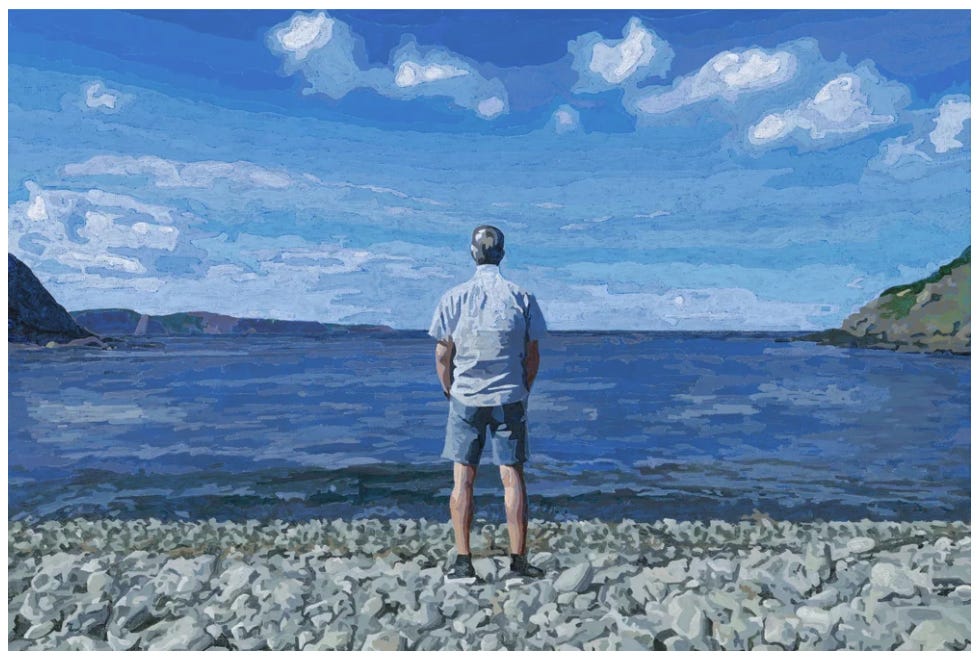
Today is my birthday.
I am 64 years old.
That used to be an old age.
Just look at the way people have thought of that specific age of all others in songs.
There are two songs about being 64.
Most of you probably went immediately to the Beatles song.
When I get older, losing my hair
Many years from now,
Will you still be sending me a valentine,
birthday greetings, bottle of wine?
And littered throughout this curious love song, the plaintive question: “Will you still need me, will you still feed me, When I’m sixty four?”
There’s another 64 song.
Some of you might know it if you are old enough and from Newfoundland and Labrador. Harry Hibb’s Sweet sixteen, but also very commonly known as Now I’m sixty-four because of the chorus:
Oh, how I long for those bright days to come again once more, but come again they never will for now I’m sixty-four.
They are bookend love songs, of a sort. The Beatles’ song is about a young man looking ahead. Hibbs’ man is older looking back, nostalgic, noticing that other things are timeless but we are not.
64 is a big number.
Mathematicians think 64 is a superperfect number because it the smallest number with seven divisors and one you can make with twice, thrice, or six times the same number using eights, fours, and twos, meaning it is a perfect square, a perfect cube, and perfect sixth power.
Math.
My worst subject in high school.
I was sweet 16 in 1978.
That was the year I got my diagnosis of Juvenile Rheumatoid Arthritis.
Maybe not so sweet.
I tend not to dwell on that these days but it changed my life. At the time, I did not understand that an inflammatory disease like JRA could be an early death sentence. At the time, it was just something that robbed me of some choices for my future and for things I wanted to do at the time. It was also painful and the treatments were limited. The best we could hope for was to limit the damage and after five years, the disease went into remission.
Other things happened that year. There’s a model ship kit on my dining room table as I write this. The sales receipt inside is from Capitol Hobby Centre, dated 03 Jul 78, a side hustle opened by Hubert Cassell, who owned Capital Drug Store on the corner of Bennett Avenue and LeMarchant Road. I had just finished Grade 10. Started work at Sears in their new A Store at the Village Mall, which opened that summer. Minimum wage. Actually a bit better. A shade over three bucks. I bought the kit out of one of my first paycheques. Fifteen dollars for the kit plus 59 cents for some glue. A buck 24 in sales tax. Still not finished 48 years later, but it will get done this summer.
I paid my way through university and only went into debt for grad school.
In 1979, I finished high school and started university majoring in political science and history. Exxon discovered oil at Hibernia. By the time, I graduated in 1985, oil companies had found all four of the major fields offshore. A decade later, after I was done with grad school on the Mainland and come back to Newfoundland and Labrador, came Mount Cashel and the election of a new government of which I was a small part.
For the generation before me and for many of my generation, the Mainland was both envy and loathing. People wanted the wealth and prosperity of Tranna but also resented the Canadian attitude in Newfie jokes or the idea that Newfoundlanders were poor, stupid, inbred, and whatever other sort of ethnic stereotype you could imagine. Labradorians were just a subspecies of the same sort of Canadian hillbilly.
I knew of no reason to feel inferior to anyone. Frankly, I found the Mainlander students, mostly Ontarians, singularly unimpressive. My fellow grad students knew little of the world beyond their immediate lives and that geographically limited upbringing left them also intellectually stunted. The graduates of Queen’s, the Harvard of the North as they fancied it, who tended to fill up the slots in the novel War Studies program had generally not been further east than Montreal and even then only on a drunken student weekend bender. In Kingston, they were only two hours by car from their homes in Toronto’s vast middle class suburban wasteland. There were exceptions, all not from Ontario.
By contrast, I had been to Europe on a federally sponsored study tour by the time I went to Kingston. My fellow undergraduate students at Memorial University had been a mix of locals as well as the children of the professionals who had come to Canada and to Newfoundland and Labrador. They too had been around. The handful of grad students were the same. My housemate at Royal Military College was a fellow from Sin Jawns I had gone to grade school with and knew all the way through Memorial as I did political science and history and he did a degree in engineering with a second degree in political science simultaneously. The graduate students from Ontario who preceded us in the program at RMC gave us both nicknames knowing nothing about us. That was a pattern that seemed to fit: an assumption of knowledge despite a lack but the confidence of privilege to not care. The names were wildly off culturally, and in my friend’s case nonsensical, as he was the child of a Trinidadian psychiatrist father and German-born professor of German mother not the Scottish Farley or Angus of the nicknames they dreamt up.
Growing up, my friends were both from families like mine who’d been in Newfoundland and Labrador for generations and those who were recent immigrants, professionals for the most part, all with eclectic histories of their own. It was a wild jumble of people from backgrounds and social classes and it was only later that I came to understand I had come up like a sprout and entirely by the accident of birth in the midst of an enormous social and economic turmoil entirely home-grown. The Newfoundland my parents had been born in a decade before Confederation was wildly different on its way to being something else.
The year I went off to kindergarten was the same year Joe Smallwood’s Liberal administration, bolstered by the influx of people like Clyde Wells, John Crosbie, Edward Roberts, and Alex Hickman, changed the provincial school system fundamentally. They relied on a report by Phil Warren to change profoundly the way children learned and what they learned. The provincial government’s education department re-organized on functional rather than sectarian lines. The churches held desperately to their control of and influence on the system through newly created denomination education councils but they were weakened. The result for a child officially registered as Anglican, like me, is that they went to a so-called consolidated school in which the major Protestant sects - Anglican, United, and Salvation Army - operated the schools together. There was no segregation by sex and in many respects the education I received more closely resembled that of a non-denominational public school than anything else.
The changes in education were significant but not revolutionary. Newfoundland and Labrador was still very much a conservative, traditional society but through the 1970s and to the end of the century it was also one full of life and change and challenges to old ways. The Progressive Conservative government elected to a majority in 1972 lived up to its name and reflected the contrary pulls of tradition and modernity. It was both progressive - there was new family law and enhancement of women’s rights, for example - but also conservative.
To secure support for the 1982 constitutional changes nationally, for example, Brian Peckford’s government bought the support of the fundamentalist Christian sects with the extension of religious rights in education to them as well. They would eventually overplay their hand in the 1990s and give Clyde Wells the excuse for the first referendum of two that ended sectarian control of education and with it the last vestige of the churches’ power over society in Newfoundland and Labrador.
By then, Newfoundland and Labrador was very different from what it had been scarcely 30 years earlier. Like other North Americans, fewer and fewer Newfoundlanders and Labradorians went to church at all. But the changes in Newfoundland and Labrador were much greater since religion played such a stifling role in all aspects of people’s lives. The old segregation present in everything from what community or what part of a community you lived in to who you went to school with and who you could marry and where you could work disappeared gradually. By the end of the century, it was already dead before the votes.
The vote in the second referendum on sectarian education showed that even a majority of Roman Catholics wanted an end to the system. That didn’t stop a handful from challenging the referendum result in court, claiming that the majority was oppressing the minority. This was impossible, of course, since the overwhelming majority of the people who voted held rights in education. The minority - almost literally a handful of Jews, Muslims, other theists and a few atheists - had no rights but also no ability to swing the final vote decisively.
The older I get the more remarkable to me is the transformation of Newfoundland and Labrador in my lifetime. There are relatively trivial things that stand out like the fact you could not drive a car from St. John’s to the ferry in Port aux Basques until three years after I was born. But then there are the more substantial things like the changes in people’s lives, their prospects, and their social and financial position.
Literally a century ago my father’s family lived in the working class slums in the east end of Water Street, across from what is now the Port Authority Building and where expensive condos have replaced the factory that stood between my family’s house and Water Street.
My father’s father died when my father was six years old. My grandfather had no formal education. He worked all his life as a labourer or as crew on ships that ran between St. John’s and England. His father rented the children out as labourers as soon as they could do any work.
Before he met and married my grandmother, my grandfather had fathered two children before he was 21 years old each by two different women, both of whom died in childbirth along with their infants. Such was the state of public health in the country, in St. John’s in the early 1920s. The two women - Marie Ryan and Anne Kenney - were from St. Joseph’s parish at the foot of Signal Hill and both girls, raised Roman Catholics, now lie in unmarked graves in the General Protestant cemetery on Waterford Bridge Road a short distance from their children who also lie in unmarked graves in the same cemetery. Their families have likely long forgotten about them. I cannot.
This is not a rare story, nor is it an unusual story in St. John’s at the time. The births register of Cochrane Street church is copied in all too many cases in the deaths register for children who if they lived through infancy might not make beyond five years of age. Flip the pages from births to deaths and try to keep count of the matching entries.
Left alone, my grandmother cleaned houses to put food on the table. She raised two children on her own. My father was the first person in his family to finish school. He got a decent job, married my mother, a nurse from Harbour Buffett in Placentia Bay, working at the Grace Hospital where she had trained. While he may have brought us home from the hospital in 1962 to public housing on Cashin Avenue, we had moved to the newly built middle class suburbs in the west end before I was in kindergarten. I was the first person in my family to attend university let alone go to graduate school.
The thing that stays with me is that my story is not unusual in Newfoundland and Labrador. At the risk of telling you rather than showing you, my family’s story like so many others across Newfoundland and Labrador is intimately bound up with the transformation of Newfoundland and Labrador through the last century and especially since the end of the Second World War.
Once I had that awareness, I started to wonder how many others do. I especially wonder if those making decisions that will affect the bright days of tomorrow are aware of how much they are tied to the bright days of today and all the bright days that went before. Vonnegut and Wolfe tell us we cannot go home, no matter how much we long for those days to come again once more. But truthfully, whether it was my grandfather in the 1920s or my father in the 1950s and 1960s or me in the 1980s and 1990s, or whether it was yours, none of us longed for the past. We faced forward, to tomorrow, to when we would be 64, even when we could not be sure we would make it that far.
End Note
For Karen, “water carries layered meanings of emotion, memory, and time. In stillness, it reflects clarity and truth. In motion, [water] exposes force and fragility. Before the cold Atlantic off Newfoundland, we confront this shifting surface as a mirror of our interior lives, where perception, like water, remains fluid and unresolved. At the edge of the sea, one simply stands and breathes, as nature becomes the only sound within. The wind sings, the waves dance—and finally, there is an exhale.”
Happy Birthday Ed and many happy returns. Your review of history brought back memories and reminded me that I tend to bunch my past as "of course" versus reviewing events in context. I have 10 years on you, so a few more experiences. I lived in Calgary and being referred to as Newf, and variations with qualifiers there of, was supposed to be a sign of acceptance and friendliness, it wasn't. Finish the Drive in 65 was an event that I do recall because I can remember my father making a comment as we drove across the TCH where it intersected with the Salmonier Line out by Holyrood. It wasn't a complimentary one about our Premier for Life at the time.
Just terrific. My first job today was to email my NP as to ongoing health issues. When I saw you had posted, and saw the title "Now I'm 64", I started to read your's first. My wife was so interested, that when I got half way, and saw it was fairly long, I paused for a break (SOB, medical term), and she said "I wants to hear the rest of it ". I then took time and emailed my NP., as my wife was gone for a walk, and I returned to what is your best post yet, (in my opinion), as it is personal reflections, and as there are so many similarities in out careers, and some big differences in our abilities. The second half was a good or better than the first. Now I have to, a little later, finish reading it to my wife. Keep Truckin.