
More EQ BS from AB
Trevor Tombe's reforms worse than imaginary problems

Alberta sovereignists gotta be fans of the original Star Trek series.
Every grievance they have is about honouring the constitution - Canada’s Prime Directive - and every argument they make, like every Bill Shatner-era Trek episode, is about violating it.
Great premise for a television series.
Lousy way to run a country.
One of the Alberta crowd’s favourite topics is Equalization. Economist Trevor Tombe has a new paper from the Mackenzie-Laurier Institute as part of the Alberta referendum campaign that takes up the tired arguments about Equalization just to write another TOS episode.
Lots of good detail for folks who don’t understand Equalization but, at the same time lots of familiar and ridiculous tropes that are the staple of the ongoing rackets about the federal transfer scheme called Equalization. Basically, as with the entire Alberta grievance list about Equalization, Trombe started with a conclusion that accepts the Alberta grievances about Equalization are valid and then piled together rationalizations to justify it.
To get into things, let’s remember three things:
EQ is about incomes not outcomes. The program has always been about how much money provincial governments have to spend on provincial things. The federal government looks at what provinces raise on their own to cover their own expenses and then they top that up, if needed, with federal money.
It’s never been about what individual governments do with the money. EQ comes with no strings attached. There are other federal programs like the health and social and transfer money that limit how province’s may spend money.
Provincial governments are sovereign within their constitutional jurisdiction.
That’s why there are no strings attached to this money. It’s one of the basic operating ideas in the constitution and it is supposedly so important in Alberta there’s even a piece of legislation to say it again. And yet, some folks in Alberta apparently have a problem with other provinces being sovereign. That’s why - as the federal description of the program says - “Equalization payments are unconditional – receiving provinces are free to spend the funds according to their own priorities.”
The money for Equalization comes from federal government revenues. No provincial government contributes to the scheme and arguably no provinces do either since the money for EQ comes from every way the federal government can raise money.
Taxes paid by Canadian citizens to the federal government from anywhere go to pay for federal government responsibilities, one of which is transfers to individual Canadians and to Canadian provinces. The same tax rates apply everywhere and, as Tombe’s charts show, the relatively more prosperous areas of the country contribute relatively more than the less prosperous areas do. Map it without provincial boundaries you’ll probably find the split between parts of the country that generate high revenue for Ottawa and the parts are produced lower amounts is more urban/rural than interprovincial.
Anyway,Trevor Tombe comes to two conclusions. He argues for a new transfer that goes to every provincial government, regardless of how much money it gets on its own.
The first would be a broad, unconditional, equal per capita transfer to all provinces – a “Canada Grant.”
He also argues for a reform to Equalization itself:
The second would be a reformed equalization program focused on horizontal fiscal imbalance: the differences among provinces in their ability to raise revenue and meet public service needs.
The existing program does exactly both those things already. Equalization is the Canada Grant. No need to rename it or pretend that right now, all provinces are not eligible for Equalization. They are. Even Alberta is eligible. But not all get a payment. That’s because EQ focuses on the “horizontal fiscal imbalance” already. That’s what EQ does. It balances the differences among provinces in their ability to raise money to deliver public services. If a province doesn’t qualify for EQ, an arguably it doesn’t need any kind of per capita transfer with no strings attached.
What Trevor doesn’t explain is that the only reason he wants to create a federal handout that every province gets is because Albertans want a federal handout despite claims to the contrary. All of their other arguments are really just a smokescreen for this one, which is that they want provincial pogey too.
The more important problem with that part of it is that Tombe’s first reform, like Danny Williams’ claim 20 years ago, invents a new idea in Canadian federalism. Trevor thinks provincial governments are entitled to federal transfers. They can collect money on their own and in addition, regardless of any other consideration, they must get another handout from Ottawa out of its general revenue. It’s nonsense. There’s no argument to justify it, which is why Trevor talks around it. He avoids it around.
On top of that Tombe invents another argument that, again, has no foundation, namely that all provinces should contribute to the federal government for Equalization but with richer provinces paying proportionately less than less wealthy ones. He argues that in “2024, the adjusted fiscal transfer out of Alberta through the federal budget was equivalent to 5.9 per cent of the province’s economy. But that outflow is driven mainly by income and consumption taxes, not equalization alone. That means concerns about regional fairness may often be better addressed through tax reform than through changes to equal per capita transfers such as the Canada Health Transfer.”
By tax reform, Tombe means lowering federal taxes on individuals and corporations in wealthier provinces just because. He makes up an imbalance in federal taxes collected from each province despite knowing that relatively wealthier parts of the country will naturally produce more revenue for Ottawa even if the same rates applied equally everywhere, as they do now. He also ignores the fact that provinces don’t pay for Equalization or anything else the federal government does. Then, to fix the invented problem, Tombe would have federal taxes lowered in wealthier parts of the country and, by implication, raised in the less well-off parts. Again, he puts the idea out there but talks around it without exploring all the implications of his ideas.
The result would increase the tax burden on regions of the country less able to pay, increase the relative advantages of the more prosperous parts of the country when it comes to economic development, all of which violates the principles underpinning the existing constitution, the tax system, and the Equalization program. Rather than reducing regional disparity, Tombe’s argument would increase it and for no reason other than some folks in the wealthiest provincial government in Canada want a federal dole cheque. What piffle.
You can see all of that just in the executive summary. When you dive into the paper itself, more problems turn up.
One is familiar to regular readers of these scribbles, namely the idea that Equalization generally or, in the more refined version, the way the EQ formula treats natural resource revenues encourages some provinces not to develop natural resources. Tombe claims his changes would reduce “the disincentives that the current formula creates against provinces boosting own-source revenue and economic growth….”
There is not a shred of evidence that EQ or the formula ever led any provincial government in Canada to avoid developing its own-source revenue, its economy, or natural resources because of how it would affect an Equalization payment. To the contrary, Newfoundland and Labrador and Nova Scotia fought for control of offshore oil and gas resources and developed them because they would end the governments’ reliance on federal handouts, particularly Equalization. The evidence is exactly the opposite of what people like Trevor claim.
Brian Peckford and Clyde Wells in Newfoundland and Labrador said exactly that. All they sought was a transitional approach to Equalization that reduced payments gradually as own-source revenues grew. Tombe seriously misrepresents events in the 1980s and 1990s, by the way, when he says that concerns of the eastern provinces was that “dollar for dollar” reduction in Equalization payments would “create a strong disincentive to develop natural resources.” The concern was that the dollar for dollar loss would leave the provincial government in exactly the same relative financial position with oil and gas merely replacing EQ payments dollar for dollar.
As it turned out, Nova Scotia’s resources were small and so it continued resource development despite qualifying for EQ continuously while Newfoundland and Labrador’s per capita provincial government revenue grew and remained far beyond what its notional EQ entitlement might have been or might be. Newfoundland and Labrador’s current financial problems are the result of chronic mismanagement not a shortage of cash and the provincial government continues with resource developments and economic growth - as do all EQ recipient provinces too - despite these imaginary disincentives.
Some of you might be screaming about all the natural gas in Quebec and the Maritimes. Then you’d point to the provinces with those resources, all of which receive Equalization. Those two things are true. But what’s wrong - what’s a logical fallacy, faulty thinking - is that the two are connected. First go back to the fact Nova Scotia already developed natural gas despite never really getting off Equalization payments. Then notice that Nova Scotia is again pushing natural gas development even thought it would lose Equalization. That’s a huge clue there’s something fundamentally wrong with this simplistic idea that - let’s be clear - also ignores the constitutional principle that provinces can do what they want within their jurisdiction.
There’s actually more to the story and it’s one that all the Albertan oil and gas, market-loving crowd worship. Well, worship in theory any way. In this case, there are three obstacles to developing natural gas in eastern Canada.
American shale gas is so cheap, that there’s no case been made that would develop natural gas in Atlantic Canada from green-field projects and let them make money.
Most of the gas is under water. That means it would take agreement among five or maybe six jurisdictions - all the provinces and the federal government - to create new regulatory agencies to run them and divide the revenue among the fields that would lie within several provincial jurisdictions. Huge political obstacle in the negotiations let alone trying to get all those provinces to agree with Ottawa.
Many ordinary voters don’t want to run the environmental risk of fracking needed to get the gas out of the ground. It’s as legitimate - and as democratic - a reason as there is.
No conspiracies. No imaginary “disincentives.” Just folks making rational decisions.

Tombe spends a lot of time talking about Quebec, which is not surprising since the Alberta sovereignist and anti-Equalization crowd are obsessed with the huge amount of Equalization that Quebec receives. The word Quebec appears at least 35 times in the text. But it’s curious see how Tombe talks about Quebec.
There are the imaginary problems of resource development, since there’s no evidence provinces avoid development to keep EQ. But Trevor is upset that the government of Quebec keeps electricity prices low for people and businesses.
Artificially low power prices in Quebec mean that resource revenues – which in this case take the form of dividends paid to the Government of Quebec from Hydro-Québec on its profits – are lower than they otherwise would be. This shrinks Quebec’s measured fiscal capacity and therefore increases its equalization payment. Given the fixed size of the program, this is not primarily a budget concern for the federal government, but it does misallocate equalization dollars.
Quebec can do this because it has plenty of old power plants that cost very little to operate, including Churchill Falls. Plus… Hydro-Quebec has a surplus of electricity it can sell at market prices into the United States to pay for it. The Government of Quebec historically has used its abundant resources to deliver benefits to its own people, which the provincial government is entitled to do under the constitution.
It’s exactly the same thing, by the way, that the Government of Alberta does by using its extraordinary resource revenues fr ok m oil and gas to deliver a “tax advantage” to residents even as it runs massive annual deficits. Tombe doesn’t mention that. He just hammers away at the idea that there’s a problem with Quebec’s scheme, which is supported by the Equalization program. There’s no evidence for it, including in Trevor’s paper, but he just claims it and carries on with his argument anyway.
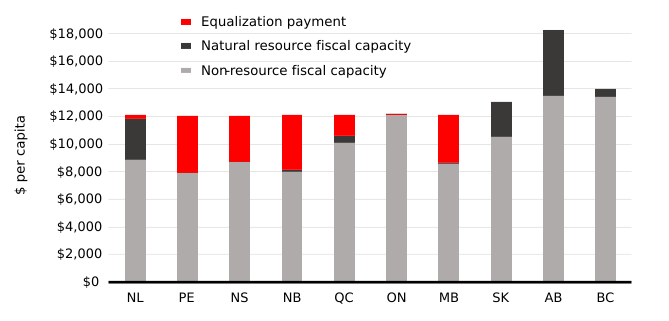
Whether you compare Trevor’s own chart at the top of this section or the latest Government of Canada chart, you can see Alberta had such a prosperous economy that even if you discount natural resource revenues but leave in Quebec’s Equalization entitlement, Alberta is still richer by the better part of $2,000 per person over any other provincial government. The idea Quebec is a problem is just nonsense. Faulting Quebec for something Alberta also does is dishonest.
As in Newfoundland and Labrador, the entire Alberta “grievance” lobby is about avoiding responsible government. There may be some minor technical problems with Equalization but that’s all they are: minor and technical. Fundamentally, the program works as intended. To argue against it, whether you are Danny Williams in 2005 or Trevor Tombe two decades later you have to literally make stuff up. And when you aren’t doing that you are ducking and dodging all the details and facts, running with nonsense ideas like “clawback” or - as Tombe does with Williams’ fight over the fiscal capacity cap - just get the facts wrong. Danny Williams was only upset because the cap screwed with his scam at the time to pocket extra cash in the transition from the old EQ formula to the new one. Williams was just trying to game the system. There was no principle involved.
Politically what Tombe and other proponents of the Alberta grievance machine are doing is shifting the political discussion within Alberta to an imaginary external enemy - Ottawa and Quebec - and imaginary problems - Equalization, Quebec policies - rather than make hard political choices like raising taxes or not subsiding the energy sector as Alberta does. The fact that the wealthier province runs deficits while Quebec delivers a wider range of services to its citizens and runs a surplus is about outcomes. More importantly, it’s only Alberta’s problem. Those outcomes are the real issue that Alberta politicians and their enablers are dodging with their talk about Equalization grievances.
Two things I like to remind my Albertan correspondents on X: if Alberta's government feels it has too little money to properly serve its residents ...
1. If Alberta's government feels it has too little money to properly serve its residents: why doesn't just raise taxes to pay for services shortages? And why did it forego the 2% GST reduction enacted during the Harper years, converting it into 2% sales tax. Quebec raised its QST by 2 percentage points, why not Alberta if it really needs the money?
Right now, what anti/reform- equalization Albertans don't realize is that they pay unusually low taxes because their government, rather than converting resource revenue (oil n' gas, in particular) into more/better services or into a sovereign wealth fund, chooses to distribute excess resource revenue to its residents, in the form of lower taxes. That's a legitimate political choice ... but one that comes at a self-imposed price. Also, lower taxes means more $$$ staying in the hands of wealthier residents.
2. If "better off" Alberta really is putting in effort to satisfy the needs of its residents ... why are its residents much LESS happy than they seemingly ought to be. The UN have published a "world happiness report" that finds that Quebec's residents, considering it as if it weren't part of Canada, is SIXTH highest in the world, up at Nordic levels. Canada's (Quebec included) overall happiness dropped from fifth to 25th in 10 years (during whose government as PM?) and to 35th (!!!) if Quebec's taken out. I don't have numbers for Alberta residents' "happiness level", but I doubt very much its hitting anything near Quebec's "happiness" KPI.
Food for thought, regarding what a provincial government's role is in satisfying residents with their lives.