
Daycare Disruption
NL's non-oil economy is sluggish, stagnant


People looking for daycare spaces in Sin Jawns will inevitably be asked by operators where they work.
It’s not an innocent question as part of a background check, it turns out. They don’t ask to make sure you can pay your bills.
Daycares screen to find people who work for the government.
Those folks tend to drop kids off after eight in the morning and pick them up around four. That saves the daycare money. They don’t have to hire staff to cover an extra hour or two at the start of the day and in the evening.
Almost four of every 10 people with a job in Newfoundland and Labrador work for the federal, provincial, or municipal government, according to figures from Statistics Canada and compiled by Bond Papers. Fraser Institute puts it at a shade under 30% but frankly that underestimates things. The average in countries including Canada surveyed by the Organization for Economic Co-operation and Development in 2021 is more like 20%, with Nordic countries tending to skew to the upper end of the range at around 30%. In Canada, the average is more like 20%, according to The Hub. Newfoundland and Labrador is well above the average and it shows.
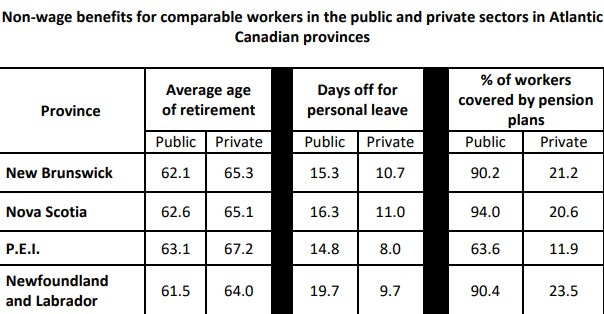
Public employees in Newfoundland and Labrador make more than their private sector counterparts, on average, and come with pension plans at a higher rate than those working in the private sector. That gives them a lot of power in the market on top of the political and economic power they’ve enjoyed since the early 2000s when Danny Williams's crowd exploded hiring and pay. It means they can seriously skew the number of available daycare spaces against people working in the private sector, too, putting the private sector at a greater disadvantage in the competition for workers locally.
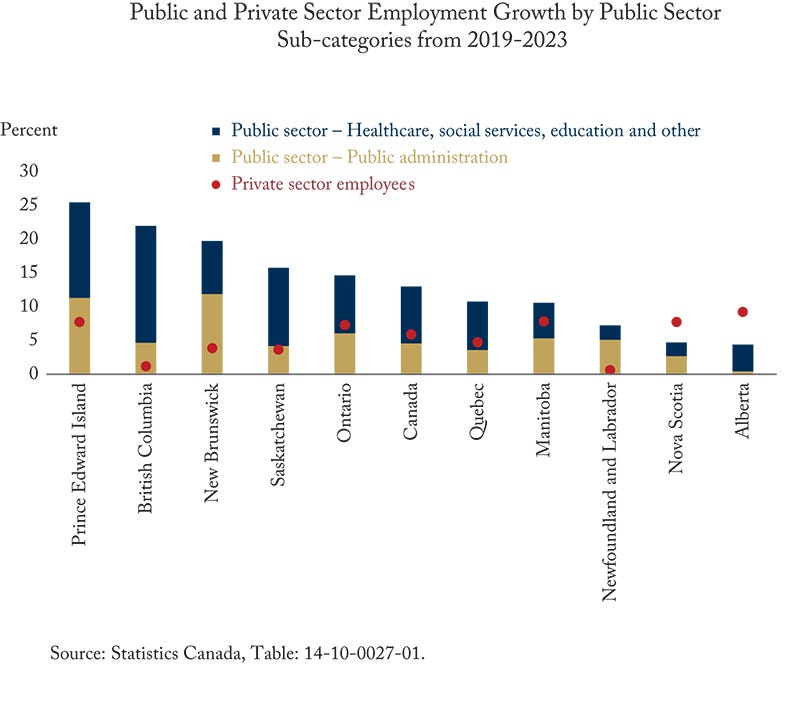
In Newfoundland and Labrador, employment growth overall trails Canada, according to the CD Howe Institute a couple of years ago, but growth in the public sector outstrips the private sector economy by leaps. “Between 2019 and 2023, Canada’s public sector employment grew at more than twice the rate of the private sector, increasing by 13 percent compared to just 5.9 percent. This shift added around half a million public sector jobs, with public administration as the largest contributor, raising the public sector’s share of total employment from 19.7 percent in 2019 to 21.1 percent of Canada’s 20.17-million-strong labour force in 2023.”
Growth in healthcare, social assistance, education and other services as opposed to administrative positions varied widely. For instance, in British Columbia, those health and social services accounted for 79 percent of the increase in public sector jobs. However, in New Brunswick and Newfoundland and Labrador, much of the growth was driven by public administration roles, representing 60 and 71 percent of increase in public sector employment, respectively.
“Since 2019,” CD Howe warned in 2024, “public sector productivity has lagged that of the business sector. As public employment continues to make up a larger share of total employment, its lower productivity could weigh on Canada’s overall labour productivity. The rapid expansion of public sector employment, contrasted with slower private sector job creation, may signal challenges for private sector expansion, which is essential for long-term economic growth.”
In Newfoundland and Labrador, public sector employment grows while the private sector is stagnant or shrinking. Federal public employment in Newfoundland and Labrador jumped 44% between 2015 and 2026 according to the federal treasury board. If you then deconstruct the Statistics Canada numbers, you find that provincial/municipal public administration - just what the provincials would call “core” public service and really best lumped together anyway - grew 37%. Don’t be fooled into thinking that’s smaller. That 37% jump provincially in the past decade is more jobs than the total number of federal public servants in Newfoundland and Labrador in 2026.
The provincial public sector growth in health care stands out especially. On the Avalon, employment in health care and social assistance is up 20% in the last decade. Across the province, it’s 28 percent. Meanwhile, goods-producing employment - fishing, mining, manufacturing, and the rest - is down 18% in the same period. The non-government services sectors are stagnant or losing jobs.
Stagnant or declining private sector.
Thriving and growing public sector.
Fifteen years ago, BP put that down to the growing fragility of the provincial economy, a word stolen from then-finance minister Tom Marshall. The series was about how government was running huge deficits, substituting outrageous increases in government spending based on unreliable income from oil for sustainable non-oil economic growth. When oil slacked off, the politicians borrowed more to fill in the holes. Between 2004 and 2010, there was never “a time when current account spending didn’t go up by at least twice the national rate of inflation. In some years, spending shot up three and four times the rate of inflation,” as we put it at the time. Public sector employment was the easiest place to see the spending growth.
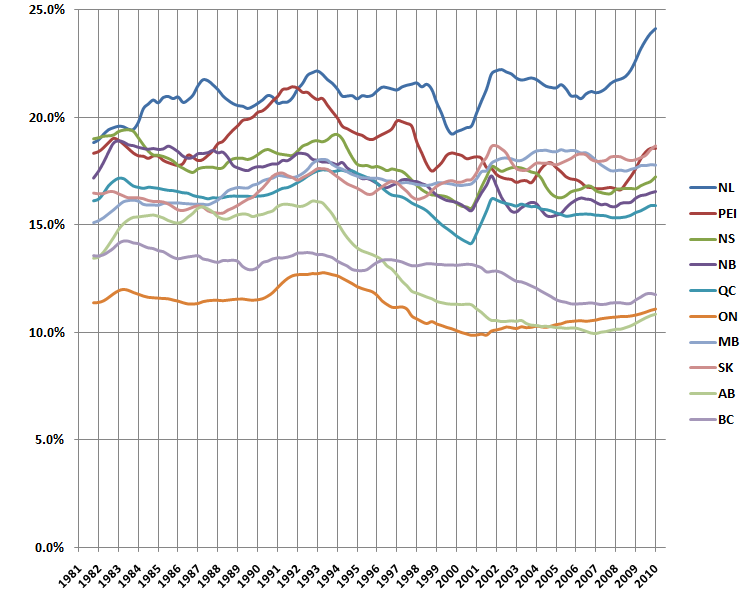
As noted in this corner in 2010, “charts [ like the one above] go a long way to demonstrating the extent to which popular perceptions of local prosperity are entirely wrong. Whatever is going on locally is most certainly not the result of private sector economic development. Rather there are more public servants making more money, 20% more, in fact over the most recent four-year contract. Couple this with the dramatic increase in overall provincial government spending – upwards of 60% in four years – and the picture is unmistakeable.” Unmistakably bad.
The Liberals came to office in 2015 promising to reduce dependence on oil and gas. That’s a financial dependence since oil and gas notoriously produces huge amounts of cash but not large numbers of jobs. Instead, they stayed the course. They pushed oil and public megaprojects like Muskrat Falls and eventually Churchill Falls and Gull Island.
They all but ignored the private sector. You can see the neglect in the fact the Liberals could pull $35 million in economic supports for new businesses one year to make it look like they were doing something for housing. That's a lot of money to have lying around doing nothing.
You can also see the disinterest in economic development as the Andrew Furey Liberals killed off the only productive and performance-based business incentive program, kept the swamp of red tape that drowns new businesses, and ignored all advice on how to promote private sector growth. Andrew Parsons had a new bureaucrat in charge of economic growth every year he was the minister responsible, another sign of the lack of interest the provincial government has in private sector growth.
The results are in the annual government budget. The non-oil economy in 2016 gave the government $5.1 billion out of the $7.5 billion it spent that year. A decade later, the non-oil share of government’s income (including federal transfers) is forecast at $6.1 billion, which is - curiously enough - half a billion below what the 2016 contribution was adjusted for inflation. In other words, the change is entirely due to inflation. There’s been no real growth.
The total budget spending in 2026 will be $12.9 billion using cash accounting, with that gap between $6.1 and $12.9 coming from oil, a bit of mining, and most of all, borrowing. But here’s the thing: that $7.5 billion in 2016 would have been $9.8 billion in 2026 adjusted for inflation. So well, then done oil part of government income rose, according to inflation, spending outstripped inflation by quite a margin. And it didn’t grow to that height because oil revenue increased to fill in the gap. Not by a longshot. Andrew Furey’s Liberals really opened the taps on spending and borrowed to cover the gap between income and outflow. Now the Tony Wakeham Pea Seas are staying the course set decades ago. The deficit this year alone will be covered by new borrowing, $3.0 billion give or take a penny.
Ignore the temporary jump in oil thanks to Donald Trump’s stupidity. That’s not going to last. And just to reinforce how wildly out of control health spending is, understand that Health and Community Services this year will cost $5.6 billion, almost all of that non-oil income. Economic development will get a mere $258 million, not even five percent of the health spending, and none of it will do anything to stop the decline of the private sector in Newfoundland and Labrador, let alone help it grow.
WOW, 3 billion borrowing this year! Going to hell in a hand basket? In a deep hole and just keeps on digging? 5. 6 billion on health care? And the system in a state of crisis on every front it seems, or actually? Lots of buildings and not not enough staff to operate. It there one area where we lead the nation in best outcomes? Ed, consider compiling a list of worst or near worst in Canada for the different things it covers, cancer, cardiac, lungs etc, different types of surgeries, wait times, nutrition, physio services etc, wait times at ER, those who refuse to go to ER, even when gravely ill, money spent per resident for health care through taxes, poor administration, transparency, numbers of scanners, and locations, distance from scanners from remote Labrador communites, locus payouts, people without doctors, restrictions on 811 NPs (restricted scope of practice), poor safety protocols, now no walk-in ECGs at the HSC (so no nearly access to ER or specialists then), cardiac patients needing urgent care, not triaged for hours at the ER, older people and those with disabilities on the back burned, patients discharged after major surgeries prematurely and then with no GP or proper follow up, requisitions sent to specialists but never received, not acknowledged, and sometime lost and having to start all over, as conditions worsening, people told they get treatment out of province, soon, and months or a year goes by and never can get an update on the status, as they deteriorate, GPs who have patients not getting a colon scope, then later finds out its Stage 4, TOOOOOOOO Late, 90 % chance of mortality in a year or so, ............ the list goes on. The arse is gone right out of her, h'ey b'y.