
Bay de Nard
Ignore the show. Go for the guts.

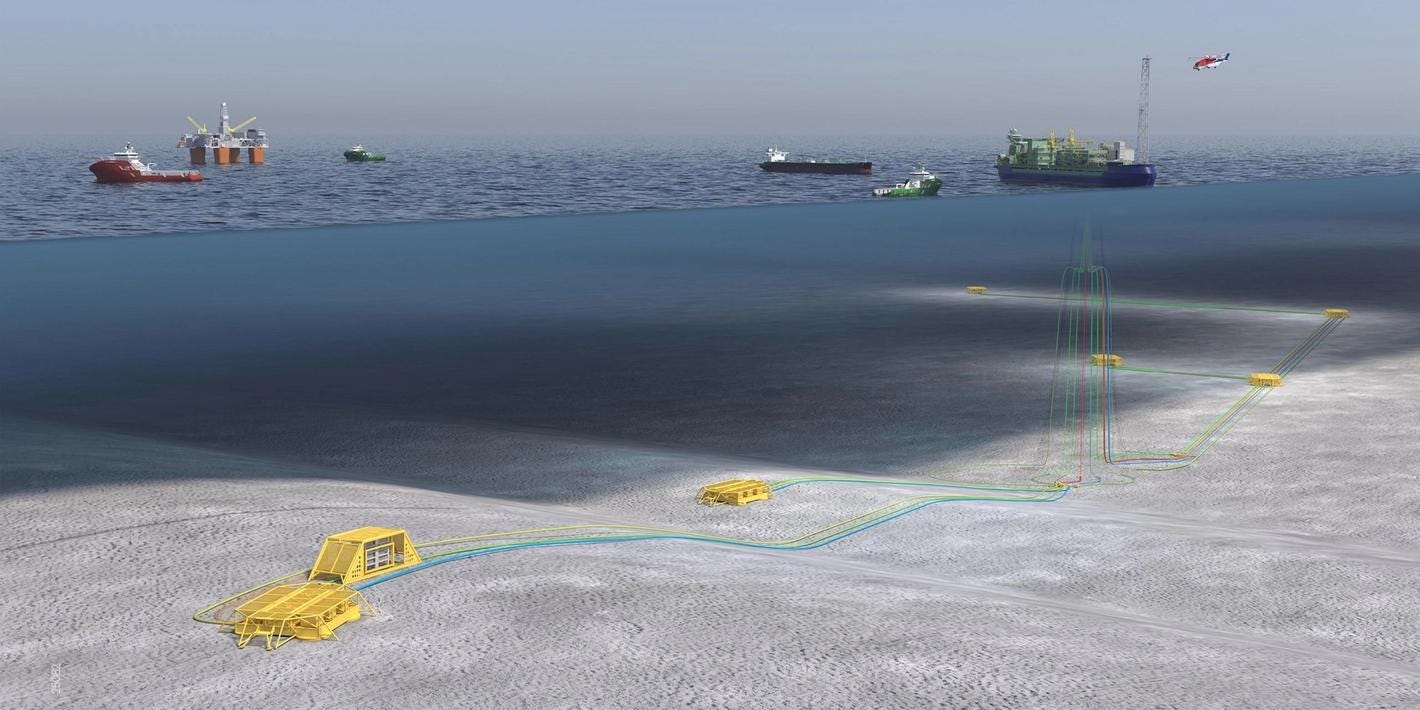
Make sure you are sitting down before you read on.
The last offshore oil development was in 2008.
18 years ago.
Let that sink in for a bit.
A child born that year is graduating from high school this year.
20 August 2008, to be exact and just a couple of days shy of the first anniversary of when Danny Williams told the world he had an outline of a deal on Hebron.
“At the current oil price of approximately $70 dollars (US) with a two per cent allowance for inflation, total revenues of $16 billion (CAD) are expected to accrue to the province over the 25-year life of the project,” the 2007 release said. A year later with another $17 a barrel on oil and they talked of $20 billion for “the province.”
That’s for the province as a whole, taking in the construction spending and all.
For the provincial government itself, we were talking more like $8 to $10 billion in taxes and royalties over 25 years. And that was with a give-away up the front end of a flat one percent royalty until the project paid off.
The cost to build the Hebron module started out around five or seven billion but wound up being $14 billion when the thing finally got underway in 2013, which was five full years later. Production rate when the thing got started was around 150,000 barrels a day, which is what the guv’mint crowd predicted.
Now we have a new project, one that’s gone through it’s share of tests and trials, only to emerge this week with a tax and benefits agreement between the Government of Newfoundland and Labrador and the project proponents Equinor and BP.
This is not the green light for the project, though. Equinor and BP will make a decision late next year whether or not to file a development application with the offshore regulator. Now that you’ve seen some of the details in conventional media and from the provincial government, let’s highlight three areas worth digging into.
Before we begin, realize that what is going on in the House of Assembly and thrown at you in the local media is all political theatre. There’s not even smoke, let alone fire.
The Pea Seas signed the deal the Liberals negotiated but didn’t sign. Every aspect of it is one that was already done and ready for signature before Tony Wakeham’s crowd pushed what was left of Andrew Furey’s bunch out the door.
We know because the Liberals said so this week. “It’s important for Newfoundlanders and Labradorians to know that this deal that was signed last night was the same deal that was on the table last fall,” John Hogan told the House on Wednesday, “and we chose not to sign that deal in part because, at that point in time, Trades NL, who are here today, told us they would not support any deal without all the topsides work being done here, full stop.”
Members of Trades NL - the organization representing unions involved in the offshore and other industries - were in the gallery watching the show on Wednesday. They approve of the deal. That makes Hogan’s admission all the more striking since it amounts to this: we didn’t sign off on this deal because the unions led by a former Pea Sea Cabinet minister who worked on the Pea Sea transition team and is now still advising them told us they would not back it.
That sounds more like the Pea Seas played the Liberals for fools than anything else. After all, as John Hogan and Fred Hutton and the rest of Hogan’s old Cabinet know, the companies are not interested in getting the topsides or any other serious bit of work done here for many reasons, not the least of which is cost. They can get a well-built ship in South Korea and make more money overall, which means the provincial government should make more money too. Local businesses can do work on the pipes and well-head bits and the other connections to get the oil from the seabed to the ship.
And truth be told, the Pea Seas knew they stood little chance of getting anything like the topsides done here. So did Trades NL. They made the political noise to get the Pea Seas elected and get the Liberals out. If Hogan and his crowd had any political sense they’d have pushed ahead with the deal before the last election and called out Trades NL for playing political games. Only Trades NL people might have voted on that basis and the rest of the industry would have welcomed the work and the money.
That’s the thing, politically. The only people crying now are Hogan, Hutton and a handful of Liberals. Everyone else is already moving on. Hogan and Hutton and getting all red-faced for nothing. There were no other issues. If there were others, better ones, the ones Hogan alluded to in the quote above, he would have used them already. Were there real issues, then Hogan’s indictment against Premier Wakeham and the Pea Seas would be whatever the Big Reasons are with the lie, the charade, the bluff, just a sleazy extra.
There are things in the announcement but in this case the stuff not there seems to loom larger. Like the relatively small amount of money the government will get from its royalty rules, which is our first issue, a real issue.
The 400-odd million barrels of oil in this project are worth around CDN$109 each right now, or CDN$43.6 billion all up. The price for Brent crude the past couple of years has gone from US$70 to US$100 but let us take US$80 as a working number.
$43.6 billion over 25 years, if the companies can recover the 400 million barrels. There is likely much more recoverable oil out there but let us start with the first 25 years
The provincial government’s take from that is only $5.0 billion in total, a mere $200 million each year on average, far less than we saw even in the predictions from Hebron or the rest. The official announcement said $6.4 billion but as AllNL explained, $1.4 billion of that would be from a 10% equity position if the government took it.
Before we get to that third point - about equity - we should wonder how the oil and gas royalty rules on this project work if it seems to be making less money than the four projects already underway. The federal government will pickup the portion that must go to the United Nations so that does not take money away from Newfoundland and Labrador so that is not it.
We used to get some idea of how they came up with the math, information about assumed price of oil, when they thought the project might hit pay-out, and other things that affect the provincial government’s haul.
But there was none of that this week.
Or in 2018 either come to think of it, when Dwight Ball announced this deal before.
Just to shine a light across the $200 million each year in royalties over the next quarter century, just realise that the cash deficit in 2025 and for most of the past decade is more than 10 times that. We would need 11 Bay du Nords just to balance the books and we have only one. Just one. Of the other four projects, three of them will wind down not long after Bay du Nord starts up and one of those might be done before the first oil flows from the Orphan Basin. This project is good. This project is a welcome addition to our provincial economy but we must wonder why the government is making so little off it.
There is a bonus issue for you, by the way, in the ridiculous pile of time it takes to go from finding oil to producing it. Not just oil and gas but any major project. The weight of bureaucracy and political tomfoolery like the topsides business is both stunned and stunning.
To get this deal worth $43.6 billion, the two companies behind it had to put up $200 million that will go to building a floating drydock. That is not enough money to build it and so the government will need to spend that much again to actually build the floating drydock.
There are questions:
Where will the other money come from? No one knows. Opposition finance critic Sarah Stoodley wants to beg Ottawa for the cash, like we were poor and backward.
Who will run this thing? Will it be another government corporation or will it get sold off to some politically connected company? What work will it possibly get?
This is a floating Bull Arm. There is lots of talk about all the wonders of it and the endless possibilities of what someone could use it before but realistically, it is Bull Arm. The place the companies built the Hibernia platform and that the government has neglected for 30 years to the point now it is a wreck.
The Pea Seas quietly cancelled a deal this week done before the last election by John Hogan’s crowd with their political buddies at North Atlantic so now the thing is back in the government’s hands, supposedly as the site to build the Floating Bull Arm. One waste of time and money will now build another. This is the sop to the TradesNL boys and girls for not getting topsides but aside from them, who will benefit from all this glorified make-work? No one.
This is what Tony Wakeham and his crowd played up on Tuesday. Did a video as well, with lots of wonder AI graphics but putting pixelated lipstick on a cyber-pig doesn’t make the pork any less porky. Better to have taken the cash and put it towards a couple of new ferries for the provincial fleet since the Bulgarian boats da b’ys bought a few years ago are duds. Better to have taken the cash and used it to fix up the university. Lots of better things than pissing the cash away and leaving the people of Newfoundland and Labrador with another rusting pile of nothing to go with the oil refinery and the rubber boot factory and the eye-glass plants and the like.
Then there is h’equity. A 10% stake in this project the government can take and will decide on before November.
Why November?
No one knows.
10% of the project would be worth $1.4 billion, as we know. The cost to get it? Another thing we don’t know but if the cost to buy-in is a share of the cost to build it, then we would be looking at $1.2 billion or 10% of a $12 billion construction job just for that bit. In 2018, when the Liberals signed off on this project already, equity would have been $1.1 billion on a project that was supposed to cost half the current estimate just to build. If we figure out the cost of all of it on the same basis, we’d be looking at $2.7 billion, or just about one year’s deficit, from which we would earn only $1.4 billion back. Regardless of how much it costs, the government does not have the money without borrowing more on top of what it is already borrowing just to keep things running or the billions is pissed away on Muskrat Falls.
Then there are all the risks. The liabilities. Imagine an oil spill. Now imagine the cost of cleaning it up, to be borne by the operators. Or imagine the cost of closing it down when the oil is gone. Another liability - money we owe in the future - like the liabilities we have for the shares in existing projects, for which no one has put aside a penny to offset.
Danny Williams and his crew wanted “equity” stakes to help borrow money for Gull Island and Churchill Falls. As things turned out, they are helping pay for the mess but not in the way Danny thought and certainly they are not enough to pay for it all.
But at the time, there was talk of maybe owning an oil company that would one day be like Equinor. Talk but no action. Just like there was talk about Bull Arm and talk now about a floating drydock but nothing ever comes of it. Instead we are left with Jim Keating and a few other ex-NALCOR employees in Big Stamp jobs at a second government owned oil company, raking in huge bonuses and doing nothing useful. A share of Bay du Nord would not suddenly start up an oil company any more than a floating drydock will be good for anything either, except stamping people up.
Before November, people should talk about equity. Talk facts not foolishness. What is it worth? What are the risks and cost? Talk it out seriously and sensibly. If there is a bigger plan, then start the bigger plan and follow up on it. Go from talk to action. But for once, let us start by talking about something sensible like whether or not an equity stake is a risk worth taking for a provincial government that is not in any financial shape to take many more risks, given the ones they stupidly did before.
I put it to the Google AI, which can to complex calculations in milliseconds, but sometimes makes a boo boo, even in math.
I inquired what is the value (over 50 years) if the Churchill River including CFs, Gull, and MFs electricity, if all is sold on the USA market, if inflation averages 3 % and electricity prices in the USA Northeast area increases an average of 6 % a year. This was based on NL owning 2/3 of CFs , 100% of MFs and 60 % of Gull. My wish was to see the comparison (not exactly apples with apples) of the MOU that offers 227 billion?
The answer: 1.41 trillion dollars, this being about 6 times the present MOU benefit. Of course the inputs are not realistic, but is interesting as a WHAT IF, and a starting point as to the potential of that River system for electricity all sold in competitive markets. And as a comparison of green vs fossil fuel energy.
Another interesting bit if data ; what is the value of 1 foot of snow or 1 inch of rain to the island grid when all is sold to residents for 15 cents per kwh; The answer ; about 17 million dollars for electricity value. Here their AI made a big error that I had to twice tell them, and was obvious to me , as Grade 5 math, as they rated rain as 170 million and snow as 17 million and then finally admitted they had the decimal place wrong for the rain!! Make no wonder that AI led missile attacks in Iran, led by the Hegseth (No Restraint Pete) ,of the War Department, blew up a girls school killing over 150.
To summarise, this project is nothing to jump up and down about. Nor even worthy of the much applause by all those who attended for the TV performance. It was sort of Tony preaching to the choir, who would be beneficiaries, and not the common Joe (or Jane), when he says all residents will see this as a great benefit. And you point out some of the liabilities, as they never mentioned one.
That you would need 10 of these to substantially dent our financial situation put it in perspective.
I will post a bit of data as to the Churchill River potential, which is a bit general but interesting and needs further clarification if correct, as to the math.