
Agency and Impotence
At home and around the world

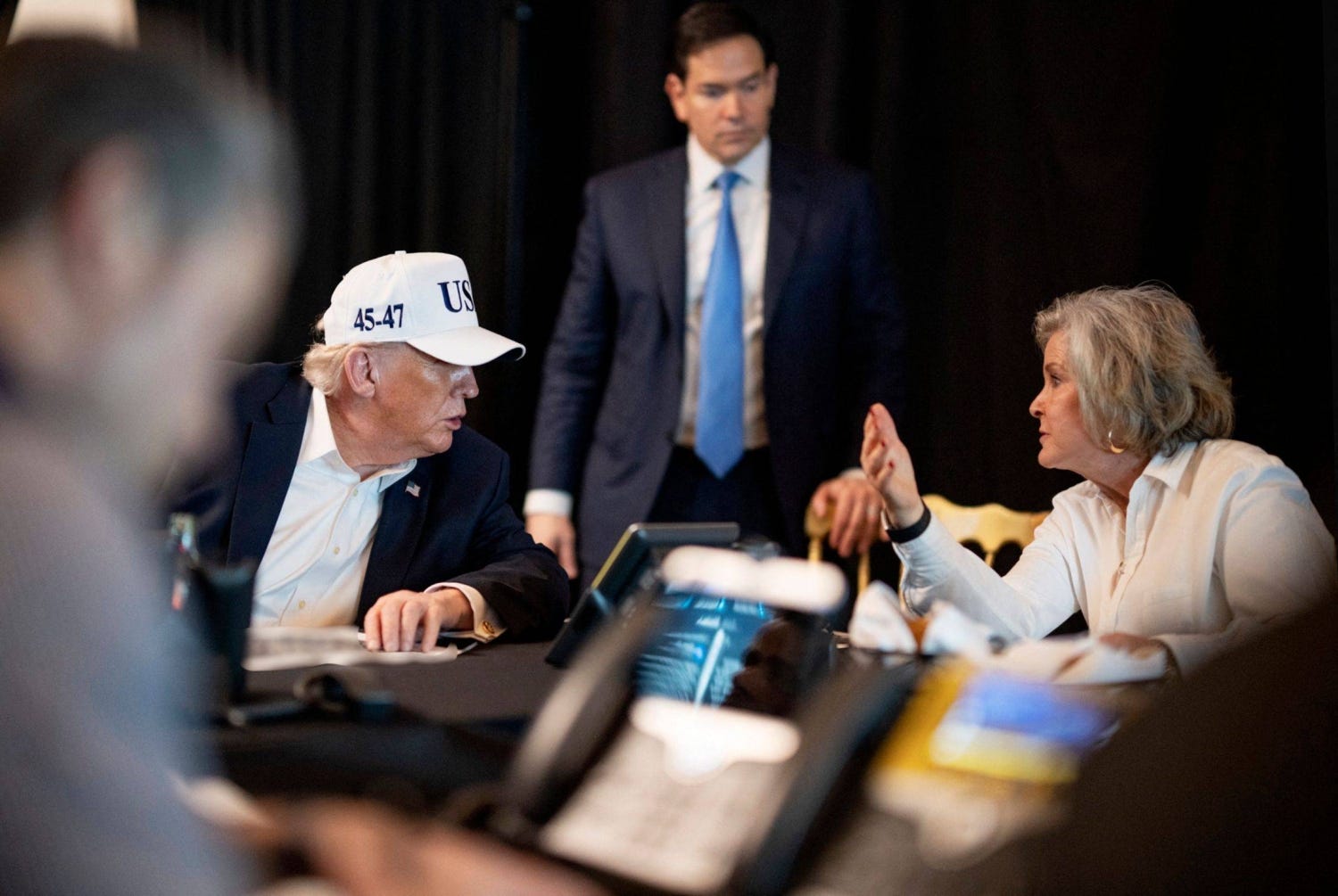
The international commentary on the American-Israeli attack on Iran is shaped by a combination of ignorance on the part of a majority of people speaking about events publicly, biases from habits of thought and action, and some measure of misinformation from the Americans in one form or another.
This was never a war nor was it ever going to be a war. It was always going to be one or a series of strikes by aircraft and missiles, limited in the number of targets and limited in duration. That was obvious once news stories appeared, apparently coming from highly-placed American military leaders, that the United States lacked the munitions stockpiles and combat aircraft to do more than a quick hit or couple of its.
Not disinformation. It’s real. American carriers are few in number, therefore have to stay on deployment longer, and that strains the navy’s short supply of equipment and people. Both are wearing out quickly. There’s a certain level on which American withdrawal from Ukraine is really about its weakness and inability to sustain itself as a global military power.
All of that was behind a point I made repeatedly on social media last week in response to comments from all sorts of folks that this was a war or about the build-up of the “largest forced since…” whatever or whenever. All hype and bullshit with coming from people within the administration or from news media and their cloud of cloudy talking heads who need emotion - excitement, fear, whatever - in order to get your eyeballs watching. They don’t know or don’t care to give anything but what sucks people in.
Call that habits of thought and behaviour but it relies on ignorance in lots of places in order to continue. Take all the ways American media treat Donald Trump and his administration as if it weren’t a gaggle of folks struggling to get anything done. All the talk of the revived Monroe Doctrine or of this Iranian escapade as a war are just nonsense. Donald Trump’s second administration is incoherent. Unfocused. Near-random. People in Newfoundland and Labrador should know this because our administrations for the past 23 years have been, to one degree or another driven by whimsy or obsessions. They were all incoherent, responding rather than acting and on the rare occasions there was a goal, going at things half-assed, like Danny Williams’ Accord policy or the Lower Churchill.
Obsessed but with no understanding of the complexity of the issues, he could make noise, put on a show, bully the weak, the compliant, and the complicit but achieve nothing. He was not ineffectual. Something happened, but it was not what Williams and his gang wanted or intended and, as with what became Muskrat Falls, disastrous.
So far, everything Donald Trump has done has turned to crap. Tariffs are the best example. Internationally, Trump’s mob have alienated long-time allies of the United States economically, politically, and militarily like no American president in modern times. His use of military force has been killing people in speedboats and, in Venezuela, parking an ungodly amount of military force offshore to do nothing more than kidnap two people.
There was no wider goal either in Venezuela or in Cuba. The latter is a by-product, and accidental consequence, not anything that could be mistaken for an objective. The same thing is happening in Iran. In Greenland, the Americans had a goal but Trump’s limited understanding of the situation and of working at the international level - he’s still basically a Brooklyn slumlord - led him to a stupid approach to a simple problem.
What Trump’s missed in all this is agency. He simply never imagined that the Danes would reject his bluster, let alone do so as forcefully as they did. He never imagined Canadians would push back as hard and as effectively as they have. In Venezuela, Trump and his administration never had a long-term goal, so whatever comes after the snatch-and-grab is up in the air.
Same thing in Iran and even 24 hours after the first attack, there was no sign of anything more substantive than a few missiles hitting different targets and no sign that killing a few people will start an avalanche that will put the Americans in a better strategic position than they were last week. Didn’t happen in Venezuela. Not likely to b e the case here as the Iranian regime has other people capable of replacing the handful of dead leaders. Lots of fundamental assumptions by the Americans apparently proved faulty but the biggest one - and the one consistent for Trump himself let alone his gaggle of seniors advisors - is that other people have agency.
Agency.
The ability to make decisions and act independently.
That’s another issue locals should understand intimately.
There’s a sentence in the report from generic Canadian university’s senate about the national anthem, the Ode to Newfoundland. Weird paragraph summarising the history of the Ode, which instead talks about Newfoundland before 1934. And the Senate or whoever wrote the report - it smells like AI slop - got it wrong.
“At the time, Newfoundland was a British colony with responsible government, and became a self-governing Dominion in 1907.”
There’s this very popular idea across Canada that Newfoundland - as the country was called at the time - was a mere British colony before 1949 and that, at least as far as that sentence goes, the place only gained self-government in 1907. By colony, those people invariably mean a place controlled totally by the British in the same way they ran Kenya or Jamaica.
There’s no small irony that Boyle got the job as Governor because his predecessor - an arrogant, overbearing, and intensely stupid fellow named Henry McCallum- tried to have Robert Bond’s administration turfed out of office. McCallum wrote to attorney general and later Prime Minister Edward Morris, encouraging Morris to break with the government because they would not endorse McCallum’s wish to send Newfoundland soldiers to the war in South Africa. Bond raised that issue and comments by the undersecretaries of war and of colonies (the equivalent of a deputy minister in Canada) and the ensuing diplomatic row led to McCallum’s early withdrawal and appointment instead to be governor of Natal.
The unimpressive Cavendish Boyle came out as the replacement and immediately sent off a note to Colonial Secretary Joe Chamberlain about the way the government ran. The Cabinet brought him orders in Council already written up and decided, tutted Boyle in his letter, which to his mind contradicted his charge as governor to run the place. Boyle was merely a figurehead. Chamberlain’s reply gently but firmly explained the reality. Boyle left in 1903, like McCallum having only served a couple of years. His replacement was someone the Bond administration picked.
Canada, by contrast, a country with exactly the same constitutional status as Newfoundland at the time, would go another 20 years before it had it out with a British governor over the limits on what he could do with the office. That’s really the most obvious thing about the report, besides the fact it got lots of things fundamentally wrong. Whoever wrote it had no idea about Newfoundland and Canada and did not care that they were so ignorant. It’s like retired Canadian poli sci prof from GCU and latterly Andrew Furey’s economic advisor, Steve Tomblin. In 2008, he told a mainland university class that Newfoundland had been dependent on Britian and now was dependent on Canada. Neither was true but Tomblin didn’t care then and does not care now about his ignorance and the consequences of it.
That notion about Newfoundland before 1949 - poor and dependent - is a common Canadian one. It’s paternalistic, as much as anything else and still sits under so much of the relationship between the two places and peoples. A decade ago, on the twin anniversary of Canada’s national day and the Beaumont Hamel slaughter, I wrote about the two solitudes of Newfoundland and Canada as well as Newfoundland and itself.
“Newfoundland and Canada, separate countries for so long, exist as two solitudes within the bosom of a single country more than 65 years after Confederation. They do not understand each other very well. Canadians can be forgiven if they do not know much about Newfoundlanders beyond caricatures in popular media, let alone understand them. But Newfoundlanders do not know themselves. They must grapple daily with the gap between their own history as it was and the history as other Newfoundlanders tell it to them, wrongly, repeatedly.”
That solitude of the generation today with the generations before, that alienation of a people from their history, has other qualities. Take Friday’s column about the growing debt load the provincial government faces. One comment left by a regular reader had a familiar ring to it:
…enjoy high deficit spending until the debt markets revolt and cut off our access to further credit. When that time comes we are forced to balance the books but that’s a future problem so who cares. Lots of us will have aged out (died) by then and the rest of us can move to the mainland and avoid the cuts to services and higher taxes.
In a separate comment, another regular read put it slightly differently but it adds up to the same thing: “the only way for our debt/deficits to get under control is when the lenders stop lending to us, and the ones holding the current debt start dictating terms. I think we will be better off if this outside entity dictates terms to us, as we are not financially responsible enough, collectively, as group of people.”
That’s in line with the view popular among some of the local elite over the past decade and a bit that there was no way to resolve the province’s financial problems without having someone else do it. Lenders cut the provincial government off. Uncle Ottawa puts the place into political receivership, that is, make it a “territory,” or, as Dwight Ball spent his time as Premier doing, begging Ottawa for this pot of cash or that, capped off by his panicked letter from March 2020 that the place was wrecked and could go no further.
In other places I have likened the attitude now to the one a century ago that Newfoundland’s salvation was in a dictatorship for 10 years, which some people would claim is what became the Commission Government. But there’s a difference between then and now, just as there was between William Coaker’s idea of a dictatorial council of 10 elected men and the appointed commission, that was not a dictatorship by any means. The difference between Coaker now and the idea of external salvation is that Coaker never assumed the saviours would be Newfoundlanders, and Labradorians if we put it in modern terms. Coaker started from the assumption that Newfoundlanders and Labradorians had agency, had the right to decide for themselves.
These days, we get the catechism of subservience, the dogma of dependence. The ideas Newfoundland was a mere colony before 1949 and that someone outside must save us - even in the self-serving version in which the wealthy make money and shag the rest of us - are rooted in the belief Newfoundlanders and Labradorians cannot govern themselves, should not run things themselves.
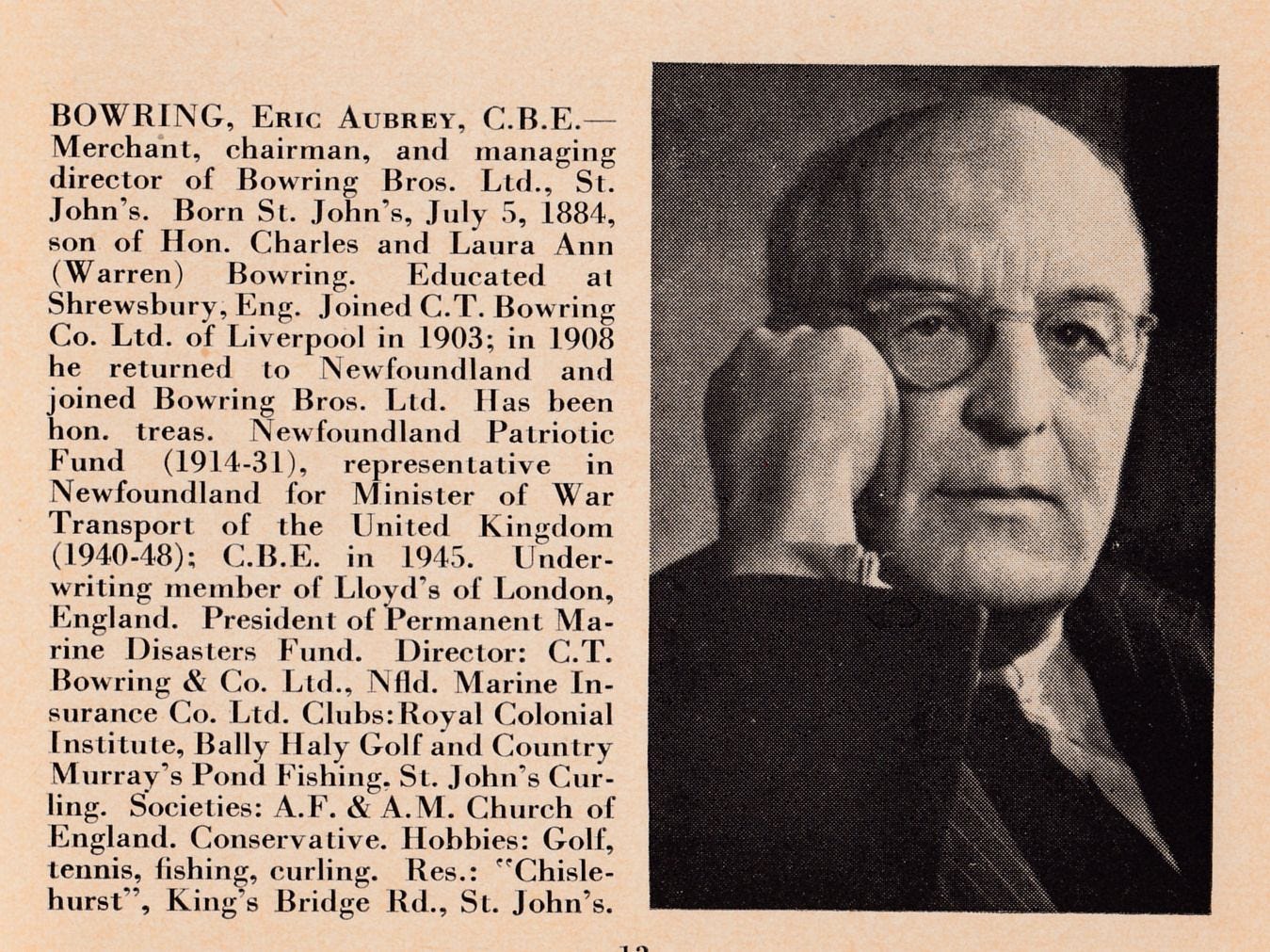
“The average person here is such that we ought never to have had self-government. We are not fit for it.” That was the opinion of Eric Bowring in 1933, part of the Bowring family of Water Street merchants offered in a confidential session with the commission appointed to investigate Newfoundland future and that led to the Commission Government. Eric’s cousin Edgar was high commissioner for Newfoundland in the United Kingdom.
That’s the attitude these days. It runs through every action of every government, including Danny Williams’ mob. After all, Williams entire message was that people needed a saviour and he was it, not that they would be able to do anything on their own. His ego-centric approach exploited the message of subordinatio and inferiority across the province. He talked like a nationalist but his actions weren’t about empowerment. The rest of us were supposed to be grateful for the “pride” he had restored. He was the key. As Williams told Rex Murphy in 2007, he felt in his heart and soul that he embodied the heart and soul of Newfoundland and Labrador.
People clamoured in 2015 for someone who would dictate. The time for democracy was past, supposedlyand in 2020 Andrew Furey talked a fair bit about how he was used to just making decisions. In practice he was autocratic, reducing the House to a sideshow but all of that came out of the same place of suboirdination, subservience and relentless messages that rob Newfoundlanders and Labradorians of their ability to decide for themselves about their own future.
Sometimes when you look at the world and look at events closer to home, the contrast slaps you in the face.
Seems for now Nl Hydro has dodged a bullet. It is slowly ramping up the LIL to perhaps 700 MW again. The Maritime link in idle mode. Not sure the max output at Holyrood, they are old but perhaps as reliable as the LIL, which is not good after 15 B gone. The LIL has improved with better software, but far from the Nlfd grid standard of 2.8 hrs down per year. Cheers to the grid operators, who now face 2 cold nights and higher peak loads
Just an update, if my source is correct; the LIL has been ramping back up toward 700MW, and is at 650, while also importing 150 from NS and now down to 120 MW, and Holyrood trolling backonnits load. The GICs that can damage the transformers is tapering to much lower levels. March 10 and March 21 to be watched as the solar events expected again, the intensity and direction of the CME is not known until it happens, as to planet earth. NL being a hot spot due to high earth grounding resistance.
If memory serves, SNC for HQ was aware of these risks and Manitoba Consultants and Nalcor ignored or buried this risk as to MFs project. I was involved in these events in the 1970s, where Corner Brook area stations having one of the highest readings of GICs in the world. These are at highest risk on 11 year cycles.